Kairos Language Specification — 4. The Body Layer
Translated from the canonical Japanese chapter spec/30-body-layer.md. The
source_shaabove records the source revision; a consistency check flags this page when the Japanese original changes.
The body layer weaves the time stream of firing instants, using the vocabulary the premise layer supplies. Write it in one line, with pipes, wherever possible.
4.1 Basic form
A body expression is pipe-centered; each stage’s arguments are named, and parentheses fix them where needed.
generator |> point transform |> selector |> …
The preamble (premise declarations) and the body expression are kept separate (§3.2). The body expression stays on one line wherever possible; the preamble need not.
4.2 Generators and windows
Generators
() → stream. Calendar-system-pure, with no dependence on calendars (I8). The inventory:
everyDay— streams everydayof the in-scope calendar system.everyInstant— streams every point of the continuous base (used withstrideBy; e.g. every 1 sol =everyInstant |> strideBy(24h39m35.244s, from: 2026-01-01). It has no upstream window, so the originfrom:is mandatory — the origin rule of §4.7).- Public boundary words of primitive definitions (
monthEnd = month |> last, etc.) — this is what generators really are, not a separate mechanism (§3.6). - Table literals (§3.8) — data-derived stream constants also stand at the head of an expression, on equal footing with generators.
Windows — two kinds, two operators
Windows come in two kinds, split into separate operators. The partition type takes a window name; the interval-sequence type takes a stream of markers. The argument kinds differ fundamentally, so the two are not unified.
![The four ways to make windows, drawn over the same nine-week strip of days (Mon 2026-01-05 to Sun 03-08): within(month) divides the axis by month, split divides the parent week into dependent windows of widths [5, 2], span bundles days five at a time (from the epoch, so starting 1/2), and segmentBy cuts intervals at new-moon markers with no window before the first marker (edges: drop). The dots in each row are the first of each window.](../../assets/figures/windows-four-kinds.svg)
Partition type within(w) — a window that partitions the axis without remainder. w is a
window name (day/week/month/quarter/year, or a user-defined partition window), resolved
under the current premise. Exhaustiveness and non-overlap are checkable (I5).
everyDay |> within(month) |> last # last day of each month
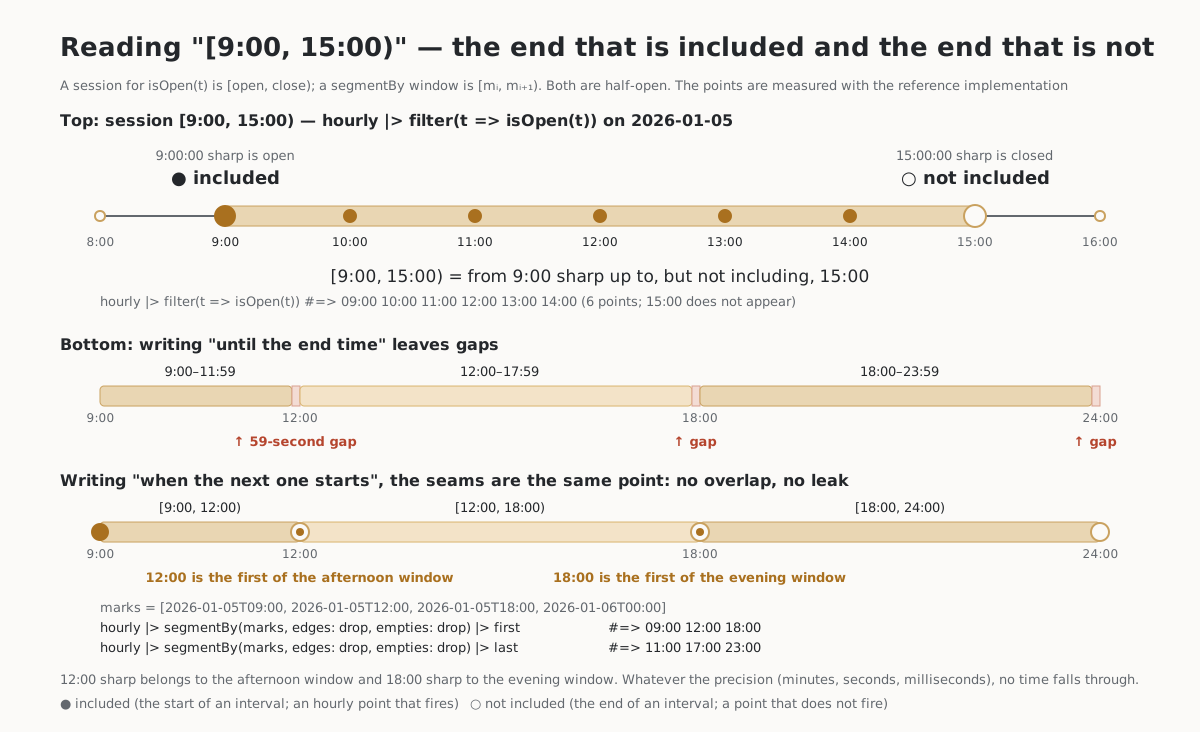
Interval-sequence type segmentBy(m, edges:, empties:) — a window that cuts at the markers of an
arbitrary stream. m is a stream expression of markers (fiscal closes, lunar phases, and so on).
Each window is the half-open interval between adjacent markers. Exhaustiveness is not guaranteed,
so arguments that state the meaning of the gaps explicitly are mandatory (I5). Omission invites
silently wrong results, hence the mandatory declarations.
edges:— the treatment of points before the first marker / after the last marker, which belong to no window.drop/clip/error. Underdrop/errorthe head side (coverage start through the first marker) is something the window sequence cannot speak for — projections andcoincidesanswer with an out-of-coverage annotation there (ADR-37 revision 3).empties:— the treatment of zero-element windows between markers.keep(a legitimate empty) /drop/error.labels:— a parallel label list for the window sequence (the vessel for ADR-39 / F62).labels[i]attaches to the window starting at the i-th marker (window-sequence ordinal = the window of the first marker within the effective coverage is 0; defining equationname(d)≡labels[window-sequence ordinal]); reading is binding-name projection (§4.9). Same-length check: list length == the coverage-based window count (= the marker count, including the final window fixed by the coverage edge; independent of the evaluation range = exact. A mismatch is an error carrying expected/actual, and runs at the same time as the evaluation of the window binding). Preconditions: the marker point sequence is finite (rule markers — theweekclass — are a static error; periodic labels are steered to cycle, computed numbers toordinalIn/label:), and the effective coverage is a single unannotated interval enclosing all markers (composite markers must first be fixed by a coverage claim). Combining withedges: clip,empties: drop, or alabel:lambda is a static error (every form that would break the label-window alignment is closed off). Empty windows (empties: keep) get labels too; the reading port is interval membership = any point within the window interval (in practice, the marker point). Only the length is guarded — checking the contents is the job of doctests andcoincides. The cyclic formlabels: cycle list anchor: real-day(ADR-47) — same as the window-binding cycle: “the window containing the anchor carries the first label” =list[(window-sequence ordinal − anchor window's ordinal) mod N](negatives normalized by the modulus). No same-length check is imposed (the expression stays unchanged as the covering grows = consistency with the static-source principle) — what is guarded is only the phase declaration; mid-sequence marker insertions/omissions and misuse on non-periodic sequences are not machine- detected (verification is the job of doctests andcoincides). The anchor is a real day interval-belonging to some window of the sequence (head side and out-of-coverage are explicit errors; coinciding with a marker point is not required). The tightening rules (clip, drop,label:cohabitation, rule markers) are inherited from the static form.
everyDay |> segmentBy(fiscalCloses, edges: clip, empties: keep) |> first
lunarMonth = day |> segmentBy(lunarStart, edges: drop, empties: error, labels: monthNos)   # lunisolar month numbers
4.3 Selectors
first / nth(n) / last. They select the Nth or the last element within a window. By default
they bind to the innermost window (the nearest within/segmentBy). Only when nesting makes the
target ambiguous is the window named explicitly with of: w. The named window carries premises
such as WKST and fixes the origin of “the Nth” (localizing the two-step dependency selector →
window → WKST). A selector without a window is a type error (I4); leaving of: off while
ambiguous is a static error.
everyDay |> within(quarter) |> within(month) |> nth(2, of: month)  # the 2nd of each month window
everyDay |> within(quarter) |> first(of: quarter)
4.4 Point transforms (roll / shift)
Point → point, lifted to streams. Two members of one family, choosing their reference premise by
argument (on:/unit:). Each stage is self-sufficient in its premises.
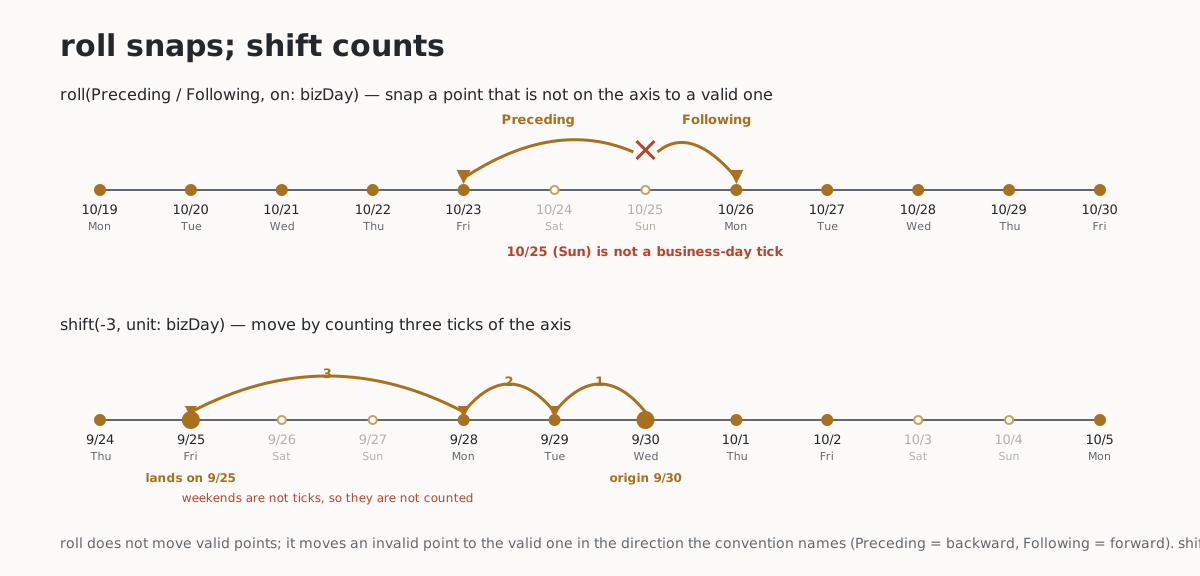
roll(conv, on: P)— nudges invalid points to valid ones by conv (Following/Preceding/Modified…). Roll conventions are axis-independent; the same system rides on business days and on DST alike.Modifiedtakes an enclosing window as an argument and stays within that window.on:accepts derived streams as well as axis names (§3.3, ADR-26).shift(n, unit: U)— moves by n (signed) in units of U. Direction is carried by the sign; no direction words are taken (back: 3would split direction across a word and a sign once n becomes a variable, and complicates parsing). When unit is a point-sequence axis (bizDay), the input and the axis must agree in alignment (§4.5; window-word units are interval membership and exempt).snapTo(w)— maps each point to the first point of thewwindow it belongs to (floor; aligns granularity seams — the instant of a solar term → its day, and so on. ADR-27/30). Its second role: because the output is constructively aligned tow’s element grid, it doubles as the explicit reattachment of the alignment claim (the canonical means of conformance for the §4.5 checks) — identity on points already aligned (ADR-36).rebase(to: "tz")(ADR-40) — preserves each point’s date label (points on an established day-grid alignment only — violation is a static error) and maps it to the first point of the civil day with the same date in the to tz (“the first instant” = ADR-33). The vessel for cross-tz “same date” composition (F69) — joint business days are(tseBiz |> rebase(to: "America/New_York")) & nyseBiz. Injective and order-preserving. A nonexistent date (a day erased by a date-line move) is an explicit error. The output alignment is the day grid of to. Choosing among the means of conformance: snapTo = chronos membership (the window containing the same instant); rebase = label correspondence (the same date); membership with time-of-day iscoincides(§4.9 — for cross-tz, first unify the tz with rebase).shift/rollgo before rebase.
@JP
monthEnd |> roll(Preceding, on: bizDay) |> shift(-3, unit: bizDay)
4.5 Combinators (union, intersection, difference) and alignment
Stream × stream → stream. The same symbols serve both calendar construction in the premise layer (adding and removing holidays) and lateral composition / exception days in the body layer.
- Union
|— merger. - Intersection
&— crossing (the points contained in both). - Difference
\— removal (removes B’s points from A). The symbol is backslash U+005C (distinct from the yen sign ¥ = U+00A5; even when a Japanese font shows the ¥ glyph, the code point is U+005C).
Prioritized overriding (the cascade) has no symbol of its own; it is expressed by
left-associative, in-order application of union and difference. Declaration order (the later
term) wins = last-wins, as in CSS layers. It decomposes: addition (citizens’ holidays) and
movement (a substitute holiday keeps the original day and adds the next) = union; inversion and
exceptions (open for business in one particular year) = difference. Everything shares a single
precedence level, left-associative; mixtures involving & (intersection) are order-dependent and
must be parenthesized.
# non-business-day cascade (premise layer, last wins)
weekends | statutory | substitutes \ specialBiz

# body layer (lateral composition, exception days)
tokyoBiz | osakaBiz          # union
schedule \ blackoutDays      # difference (both sides day-granular; excluding from timed streams is coincides = §4.9, ADR-38)
Alignment checks (ADR-36)
Point identity is equality on chronos (ADR-33). To stop the matching of two streams of mismatched
granularity — everyDay \ instants never coincides at a point and is a silent no-match — a
static alignment check is placed on every operation that decides membership by point equality.
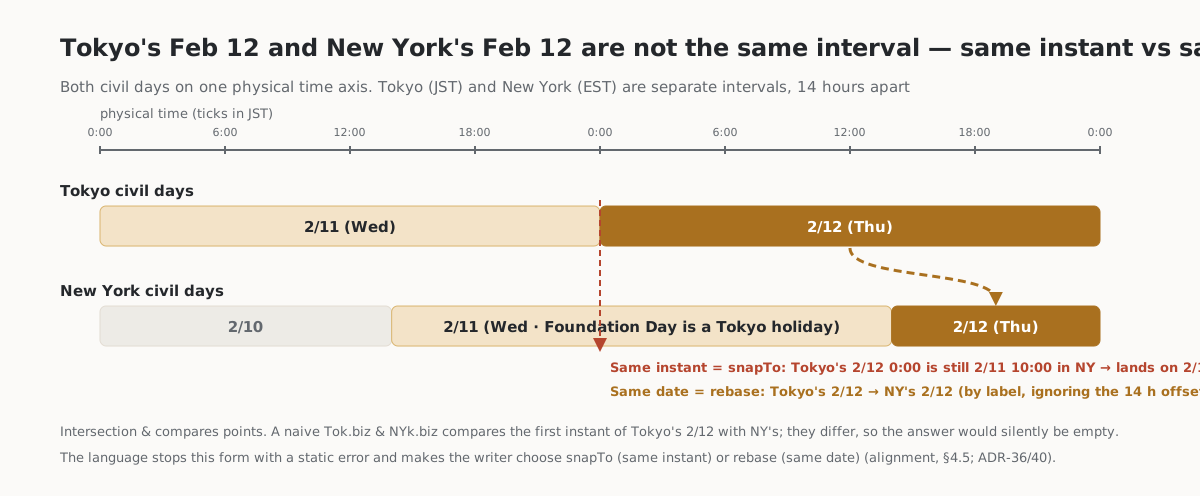
Alignment is a static property of a time stream — “every point lies on a tick of some atomic
grid G = (width, normalized phase, tz name)” — a claim computed from the derivation structure of
the expression (its value is three-way: some G, “none”, or “vacuous conformance”; ADR-36
revision 3). Vacuous conformance = the alignment of the empty table ([] covering:, ADR-45):
having no points, it can violate no G — it passes the check (even against a “none” partner)
and in combination inherits the partner’s alignment (in contrast to “none” = cannot claim,
fails the check). A window word’s element grid = the atomic grid of its window chain (for
month/year/week, the day grid). The check at a glance:
flowchart TD
  OP["S₁ ⊕ S₂ (⊕ = &, difference, filter(on:), roll(on:), shift(unit: point-sequence axis))"]
  OP --> Q{"G(S₁) = G(S₂) ?<br/>(width, normalized phase, tz name)"}
  Q -- "yes" --> OK["composition OK — result on the same G"]
  Q -- "no" --> ERR["static error (sealing off the silent no-match)<br/>guidance: snapTo(w) = explicit realignment, rebase = label correspondence<br/>for same membership, coincides (§4.9)"]
  UNION["S₁ | S₂ (union)"] --> FREE["no check — protecting mixed schedules"]
| Form of expression | Alignment |
|---|---|
everyDay, public-window-word derived (month |> first, etc.) |
element grid (for Gregorian, the day grid) |
| table (all elements lexically date-only) | civil-day grid (tz = the tz used to anchor the literal; entity and data premises converge to inner fixing) |
| table (containing timed or non-lexical elements) | none |
empty table ([] covering:, ADR-45) |
vacuous conformance (conforms vacuously to every alignment, passes the check; preserving stages preserve vacuous conformance) |
filter, selectors, within, segmentBy, stride, take, takeLast |
preserves the input’s alignment |
roll(conv, on: A), shift(n, unit: point-sequence axis A) |
the alignment of axis A |
shift(n, unit: window word U) |
preserved if the input alignment = U’s element grid, otherwise none (no check = interval membership) |
snapTo(w) |
claims w’s element grid (= the explicit means of realignment; for windows from segmentBy, the markers’ alignment) |
strideBy(w, from: p) derived (including materialized everyInstant) |
anchored grid (width w, anchor p) |
rebase(to: "tz") |
constructively claims the day grid of the to tz (= label-correspondence realignment; ADR-40) |
A | B |
if both sides are identical, that; otherwise none (if one side is vacuously conformant, inherits the other) |
A & B, A \ B |
the common alignment (the check guarantees identity; if one side is vacuously conformant, inherits the other) |
The check: &, \, filter(on:), roll(on:), and shift(unit: point-sequence axis)
require that the alignments of both sides (input and axis) be the same G (stride(n) left the
check’s scope with its input-relative fixing = ADR-38 — it reads nothing but its input, so there
is nothing to match). Either side being “none”, or a G mismatch, is a static error (in the layer
after binding resolution, before data evaluation) — except that a vacuously conformant side
always passes (there is no point that could violate; ADR-45). There is no automatic conformance
by refinement (a lax judgment of the kind “timed and daily do line up on the tick of hours” would
let a no-match in the intended unit through). The explicit means of conformance are divided by
intent — if you want the same points, conform with snapTo; if you want the same
membership (the same day, etc.), use coincides (§4.9, ADR-38; the error message also guides
this fork). Equality of tz names is literal string equality (before link resolution, no
normalization; "UTC" ≠ "Etc/UTC" errs on the safe side). Union | asks no alignment (points
are only added, with no danger of silence — a mixed schedule is a legitimate form; the mixed
output becomes “none” and is caught by downstream checks). Operations that decide by interval
membership (within, segmentBy, snapTo, projections, cycle projections, coincides) are
outside the same-G check — but the tz-name check is laid over the exempt family too (ADR-36
revision 2, ADR-40): a tz-name mismatch between a civil-grid input and the window’s element grid
is a static error (width and phase stay unexamined; once rebase makes cross-tz alignment
routine, the exempt family’s “bundling with a one-day label slip, weekday reading” would pass
silently — tz alone is the date coordinate system itself. snapTo is excluded because chronos
membership is its documented meaning). Details in ADR-36 (including revisions).
4.6 Filters
Thin by predicate. Calendar dependence starts here (I8). Both forms are taken: the premise
predicate filter(on: P) (names an axis, resolved against the in-scope calendar) and the
value-expression predicate filter(y => condition) (a lambda) (where was folded in). Inside the
lambda, the value functions of cycle labels (weekday(d) == Mon; §3.6) and window-to-value
projections (§4.9) are available. filter(on: P) is membership by point equality, so it requires
the input and the axis to agree in alignment (§4.5, ADR-36 — a mismatch is a static error, never a
silent no-match).
everyDay |> filter(on: bizDay)                       # keep business days only
everyDay |> filter(d => weekday(d) == Mon)           # keep Mondays only (label predicate)
4.7 Strides (scan and thin, or cut off)
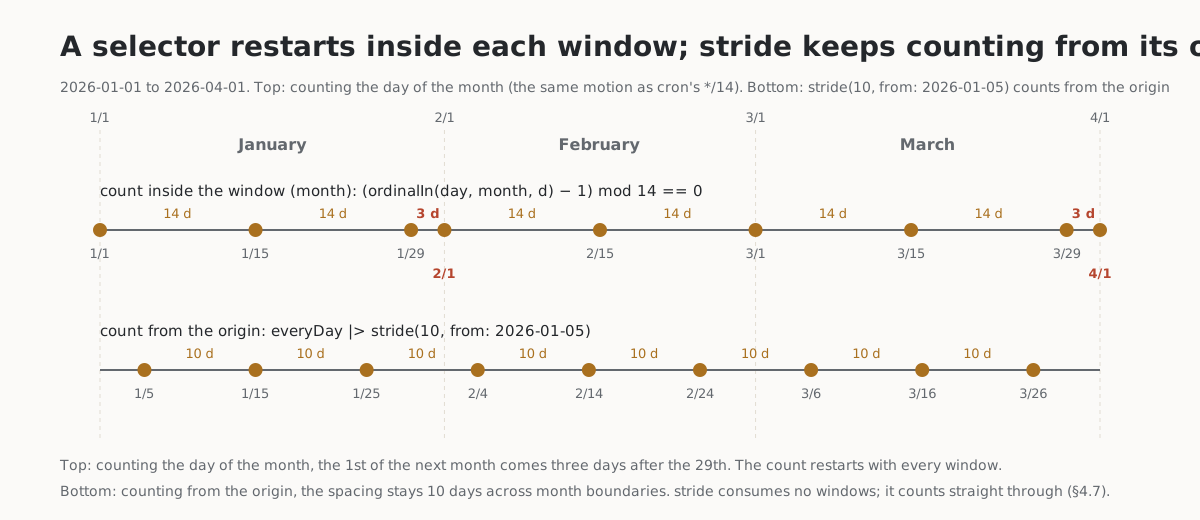
A stateful online transform, a family apart from selectors. Where a selector consumes a window and picks “the Nth” window-relative (each window → one point, resetting per window), a stride consumes no window and counts through (continuous across boundaries, never resetting). “Every N business days, ignoring month boundaries”, “five sessions total” and “the last three firings” cannot be written with selectors — that is the stride’s reason to exist. It splits into four operators by argument kind and how the count is used.
| Operator | Argument | What it counts | Example |
|---|---|---|---|
stride(n, from:) input count, thin |
integer ≥ 1 (violation is a static error) | points of the input stream (no axis argument; ADR-38, F70) | filter(on: bizDay) |> stride(3, from: …) = every 3 business days |
take(n, from:) input count, cut off |
integer ≥ 1 (violation is a static error) | points of the input stream (only the first n pass. ADR-49) | (lessons \ cancelled) |> take(5, from: …) = five sessions total |
takeLast(n, until:) input counting, cut off at the tail |
an integer ≥ 1 (violations are static errors) | the input stream’s points (passes only the last n points at or before until:. ADR-52) |
tensha |> takeLast(3, until: …) = the last 3 firings |
strideBy(w, from:) width step |
a width = a physical quantity across multiple axes | width (an absolute amount) | strideBy(24h39m35.244s, from: …) = every 1 sol |
stride, take and takeLast are input-relative — what they count is decided upstream (“every 3
business days” puts filter(on: bizDay) first). The counting origin is “the first input
point at or after from:” (that point is step 0 = it survives; from: is not required to be a
point of the input). The form “count along an axis, apply to another stream” is composed as
(stride sequence of the axis) & input (day-aligned) or
filter(d => coincides(strideSequence, day, d)) (timed; §4.9).
take is the COUNT counterpart of RRULE, but counting after exclusion falls out of
composition order — in (lessons \ cancelled) |> take(5, from: …), later points move up to fill
the n as exclusions remove earlier ones (structurally avoiding COUNT’s trap of counting the
generated set before exclusion and shrinking). After the nth point the output is a legitimate
empty (no annotation; ADR-37 decision 2). Windowed input is a guided static error — the
per-window “first N” is within followed by nth (§4.3) or an ordinalIn predicate (§4.9)
(take counts through). Time-boxing belongs to the separation of definition and evaluation range,
not to take.
The anchor (the phase anchor) is always made explicit (absence is a static error; common to
the family — from: as the origin for stride/take/strideBy, until: as the terminus for
takeLast (the dual of from:; mixing them up gets a dedicated diagnostic. ADR-52)). The former “supplied from the upstream window’s origin” was
abolished: with multiple windows it is ambiguous and evaluation-range-dependent (in tension with
I7) (ADR-31, F49). No reset by default (boundary-ignoring, continuous). The per-window
recounting variant is written by reduction to ordinalIn (§4.9, ADR-27).
@JP
everyDay |> filter(on: bizDay) |> stride(3, from: 2026-01-05)    # every 3 business days (origin explicit via from:)
4.8 Sugar definitions
Sugar (monthEnd, businessDays, nextWeekday, etc.) is shorthand that names a composition of
the core family, erasable by expansion into core (one-way dependency). Its definition needs no
dedicated new syntax: write a core pipe sequence on the right-hand side of the existing binding
= (§3.5), nothing more. It is the same = binding mechanism as the §3.5 value function
isLeap = y => … and the §3.6 public word monthStart = month |> first, appearing with a
different type on the right-hand side.
Defining a binding of the same name twice is a static error (top-level bindings and bindings inside a premise block alike; a
later definition never wins silently; overriding a base’s public word through a derived with is unchanged). Applying a lambda
whose parameter count differs from the argument count is an error (1.0 addendum 22).
Sugar inherits the meaning of its expansion — the transport rows for evaluation annotations (§4.10, ADR-37 decision 4) and the
DST conventions are those of the core words that appear in the expansion. That the inner filter of the standard sugar at (§5.5)
drops out-of-coverage points and annotates is a consequence; sugar gets no special treatment outside the transport table (ADR-51
addendum 2). The difference between stages — combinators keep points whose existence is known, with an annotation; predicates drop
points whose truth is unknown, with an annotation — is the difference between “the point’s existence is known” and “the predicate’s
truth is unknown”, not a per-stage convenience (settled 2026-10-01; the record is in design/91-closed-questions.md).
Base form B (explicit lambda) — bind the upstream stream with s => and flow it into the core
sequence with s |>. |> keeps its single meaning, “value → application of a transform”.
businessDays(on: p) = s => s |> filter(on: p)
nextWeekday(d)      = s => s |> roll(Following, on: (everyDay |> filter(x => weekday(x) == d)))
Shorthand A (point-free) — if the upstream s merely flows straight through (the head is
s |> and s appears nowhere else), s => may be dropped. This is B’s eta-reduction — sugar for
the sugar definition itself (self-similar). With it dropped, a transform stands to the left of
|>, so |> also carries “transform |> transform = composition”. Within the frame of “connecting
stages”, application and composition are distinguished by type (value or transform), and the
one-role principle is preserved.
businessDays(on: p) = filter(on: p)
nextWeekday(d)      = roll(Following, on: (everyDay |> filter(x => weekday(x) == d)))
nextWeekday(d) (advance to the next d-weekday) expands to a forward roll — with the sequence
of d-labeled days as the axis, it nudges every non-d point to the next d-weekday. It passes
through no week window and is therefore WKST-independent (the former within(week) expansion
picked “the d-weekday of the same week window” and could jump into the past for points late in the
week; withdrawn in 40-examples F31).
Sugar that uses the upstream by name (branching and rejoining) cannot fold into A; write it as B.
No declaration marker — that something “is sugar (expandable into core)” is decided
automatically by dependency analysis, from the right-hand side depending only on core words (plus
default sugar). No sugar keyword or the like is introduced. Core words (generators, point
transforms, combinators, filters, windows, selectors, strides) are built-in reserved words of the
language; every other named binding is sugar or a public word. A binding that redefines a core
word (breaking the one-way dependency) is a static error.
Expansion is finite — definition cycles (self- and mutual recursion) are guided static errors (F110; the formal rule lives in §5.3 — it is the very premise of “expanding all sugar leaves only core”, so recursion cannot be written).
Premises are not baked in — resolution is deferred — sugar does not fix its premises at
definition time; it resolves them against the in-scope premise at the call site. nextWeekday’s
weekday label resolves from the calling context’s calendar system; the sugar itself knows no
calendar system. The week window’s wkst reference (§3.6) stands on the same rule. The
complexity is borne by the core it expands into; the sugar stays thin.
Deferred resolution covers premises only — the caller’s value bindings are not visible
(ADR-53): a bare name on a binding’s right-hand side can resolve to bindings, premise public
words, preamble members, and enumeration labels — and nothing else. It never falls through to
the caller’s lambda variables (the d of filter(d => …) and the like); that shape is a guided
static error — a binding’s meaning closes over its own definition and does not depend on the
variable names at its use sites (a point-dependent value is written as a parameterized binding
T(x) = …, used as T(d)). Lambda variables bound inside the right-hand side itself
(the x of thirds = everyDay |> filter(x => …)) remain legal as before.
Expansion = mechanical insertion of the right-hand side — x |> nextWeekday(Fri) inserts the
definition’s right-hand side and opens into
x |> roll(Following, on: (everyDay |> filter(x => weekday(x) == Fri))). Expand all sugar and
only core remains. The premise layer’s pipe sugar (rephase; §3.7) is the same one-way
expansion; that one opens into the with of premise → premise.
4.9 Window-to-value projection (the connection to value expressions)
As the dual of selectors (window → point), there are projections that read a value from a
point by way of “the window it belongs to” (ADR-27/30). They are used inside value expressions
(lambdas) and, combined with filter, build expressions that “select by window coordinates”. The
core of the reading side is these three words.
| Word | Type | Meaning |
|---|---|---|
ordinalIn(u, w, d) |
point → number | Within the w window containing point d, the ordinal of the u window containing d (1-based). ordinalIn(day, month, d) = which day of the month. The counting unit u is explicit, so it does not depend on the input granularity. Alignment check (ADR-50): when u is an elapsed-width grid, an explicit error if the start of d’s w window is off u’s lattice (zones whose epoch difference is not an integral number of unit widths — no silently fractional ordinals; per-instance, in the data-relative layer) |
epochOrdinal(u, d) |
point → number | The running ordinal of u windows from the epoch (the same coordinate as the window ordinal of §3.6; 0-based; negative before the epoch. The epoch is the language default 1970-01-01, overridable by the calendar system’s epoch:. For data-derived windows whose sequence does not reach the epoch, the first existing window is 0 = ADR-31 revision, F60) |
coincides(S, w, d) |
point → boolean | Whether at least one point of stream S lies within the w window containing point d (the window-membership predicate = bounded existential quantification in value expressions; ADR-38, F68). Alone in the family, its first argument is a stream (a window word is a static error — get a point sequence via month |> first) |
coincides is the vessel for F68 (applying exception days to timed and mixed schedules); the canonical form is notices |> filter(t => not coincides(closures, day, t)) (preserve the firing time, exclude by “day”). The intersection form is the same single word: difference versus intersection is written by the presence or absence of not.
- Membership is interval membership, with no alignment requirement (the exempt family of ADR-36 decision 7). But if S’s alignment is a civil-time grid whose tz name disagrees with w’s, it is a static error (preventing the silent one-day cross-tz slip; coincides is chronos membership, not “the same date label”; F69).
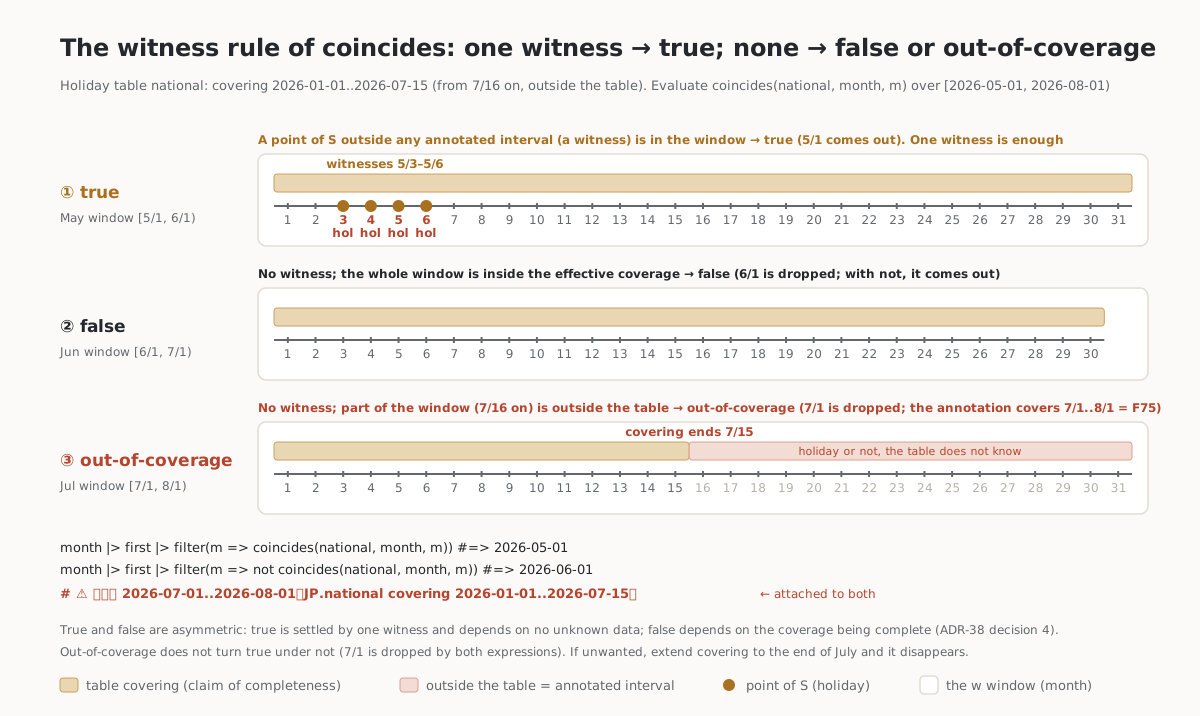
- Determination is the three-way witness rule (ADR-38 decision 4). If a point of S from an unannotated interval (a witness) is in the window, true. With no witness, if the window intersects an annotated interval of S, out-of-coverage (§4.10; the final window closed at the coverage edge has an undetermined end, so with no witness it is always out-of-coverage, never settled as false. ADR-37 revision 6). If the window lies entirely within the effective coverage, false. Points of a degenerate computed value (the data-exhausted tail of
everyDay \ holidays) are not witnesses. - Choosing between the two: for exception days between day-aligned streams the combinator (
schedule \ blackoutDays) is right. “Same point: combinator; same membership: coincides”.
The witness rule’s three branches:
flowchart TD
  Q["coincides(S, w, d) — is a point of S in the w window containing d"]
  Q --> W{"is a point of S from an unannotated<br/>interval (= a witness) in the window?"}
  W -- "yes" --> T["true — ∃ is monotone. A witness's existence<br/>depends on no unknown data (no annotation needed)"]
  W -- "no" --> C{"does the window intersect an annotated interval of S?<br/>(the final window closed at the coverage edge touches it = intersects)"}
  C -- "yes" --> O["out-of-coverage — in filter, drop the point and annotate<br/>(widened to the whole window read = F75)"]
  C -- "no (window within the effective coverage)" --> F["false — determining false depends on coverage completeness<br/>(the asymmetry with true is normative)"]
Labels are read by binding name (no generic labelOf word; ADR-30). Apply the binding name
itself, as the projection name, of a labeled window/cycle/table to a point — weekday(d),
sekki(d), lunarMonth(d). This generalizes §3.6’s “a cycle binding name is a point → label
value function” to every label source. Points store no labels (a time-stream point is an
instant only, and the value type is likewise untouched). A label is a point → value projection;
its sources are three — a cycle’s rhythm, label: attachment, and calendar-coordinate value
functions — and the reading side is uniformly name(d).
Window-instance reference — the dual of binding-name projection (ADR-42; the typing rule of
application is §2.7). Applying a value to a window binding that carries a label source
(label:/labels:) returns the contents of the windows with that label, as a time stream (the
preimage):
W(v) ≡ element point sequence of W |> filter(d => W(d) == v) # year(2020) = the days of 2020
Element point sequence = of the input point sequence that W’s definition bundled into
windows, the points that belong to W’s windows (in a grid/span/split chain, equivalent to the atomic
grid’s ticks; under segmentBy, the input stream’s points. An internal concept — no new word for
users to write). The resolved value’s alignment inherits the input’s alignment, so
marineDay & year(2020) (narrowing to a specific year — the canonical form of F9) coexists with
the §4.5 alignment checks. When a label is not unique, the result is the union of all matches
(kyuMonth("六月") = the sixth month of every year; number labels are not unique keys —
lunarMonth(6) includes the leap sixth month, which repeats the preceding month’s number); empty
windows and zero matches yield empty. But for bindings whose label value domain is statically
enumerable (labels: literals and the like), an out-of-domain value argument is a static
error (sealing off month(2020)-class typos going silently empty; computed labels are “no match
= empty”). The scope of application is window bindings only — preimages of cycles and tables are
not introduced, because they can be written as one filter line over the carrier’s point sequence
(everyDay |> filter(d => weekday(d) == Mon)). Applying a value to a window binding with no label
source is a static error (attach label: or write a filter). Annotation transport is the “window
sequence → element point sequence” row (the output’s annotated intervals = the complement of the
window sequence’s effective coverage) plus filter’s existing rule (§4.10). In the standard
premises, year and month (Gregorian) and year (Fiscal) carry standard labels
(month(5) & year(2026) = May 2026). Mind premise-relativity — under Fiscal, year(2020) is the
2020 fiscal year. If the calendar year is wanted, use the qualification pin
Gregorian.year(2020).
snapTo(w) (§4.4) is a point transform of the same family (it reads the window’s first
point). With this family one can write fixed days (dayNo(d) == 11), rokuyō
((month number + day ordinal) mod 6), Easter as an instant, and “every n, reset per window”
(filter(d => (ordinalIn(day, w, d) - 1) mod n == 0) — the per-window-reset version of the stride
reduces to this and gets no dedicated notation). The calendar coordinates
yearNo/monthNo/dayNo are sugar over epochOrdinal + ordinalIn + existing value functions
(yearOf/monthOf). No value → instant lifting (dateOf) is introduced — projection plus
filter suffices.
The attachment side of window labels (the label: argument at generation time) is written as a lambda, which binds the window’s first point (the representative point) (ADR-34). The semantics is the one-line defining equation name(d) ≡ attachExpr(first point of the window containing d); evaluation is at projection time, deferred (I7); bare names inside the attachment expression are premise-relative (ADR-17).
- The attachment expression may refer to any window or projection of the representative point (a fiscal-year label
label: (p => yearNo(p)), ordinal lookup into a parallel list). Adjacent-window reference is out of range (I7). - Self-reference (label projection of the binding name under definition, and value-argument application; the preimage subsumes the projection; ADR-34 revision / ADR-42) is an explicit error. It is detected at projection time: bare names in the attachment expression resolve lazily, so it cannot be decided statically.
- There is no point-±-width arithmetic in value expressions (the old example “ISO week’s Thursday → year” was transformed equivalently by F57, making the
label:itself unnecessary). - Labeled data is a point sequence plus a parallel label list (
labels:; §3.8, ADR-30). The samelabels:attaches to window sequences too (§4.2, ADR-39). The three-source symmetry: table + labels: (data labels on points), window + label: lambda (rule labels on windows), window + labels: list (data labels on windows). When merely pasting a data column,labels:is canonical; alabel:lambda only for computations that need an index expression.
The family’s names (ordinalIn, epochOrdinal, snapTo, label:, labels:) were fixed at RC2 (§5.4).
Types in equality — both sides of == / != must be of the same type (number, string 〈label〉, boolean, point,
time-of-day). Comparing different types is an error, not a silent false (1.0 addendum 22). The identifier form and the string
form of a label are the same string value and therefore equal (§5.5). A zero on the right of /, mod or div is also an error.
4.10 Evaluation annotations — out-of-coverage origin (ADR-37, I6)
Data runs out (the official calendar bulletin is gazetted annually; exchange calendars extend only through the next year). Make evaluation past the end “silently empty” and you have a silent failure; make it “stop with an error” and every evaluation touching even part of the coverage dies wholesale. Kairos takes a third way — the value is always determined, and the danger is always observable as an annotation (the orthogonality of value determination and danger reporting; the concretization of ADR-15’s “empty is a legitimate value, origin is an evaluation annotation, judgment is external”).
Out-of-coverage annotations: alongside the result stream runs a sequence of annotated
intervals on chronos — for each [a, b): kind, source (premise.binding-name), covering, asof. For
now the kind is the single “out-of-coverage” — marking the intervals where the result may
depend on what lies outside the data coverage (covering: §3.8). Annotations attach to
non-empty results too (rule-derived points keep flowing in out-of-coverage intervals). The
absence of annotations says only “not caused by a known data edge” — it is no proof of
correctness (a typo’s total drop-out goes to external judgment as an empty result with zero
annotations). An annotation is an adjunct of evaluation, not element data of the value (I6 — the
same stance as ADR-30’s “points store no labels”). The relation among coverage, evaluation range,
and annotations:
gantt
    dateFormat YYYY-MM-DD
    axisFormat %Y-%m
    title Example — holiday data covering 2026, evaluated over 2026-07 to 2027-06
    section Data
    covering of holidays (claim of completeness)  :done, 2026-01-01, 2026-12-31
    section Evaluation
    evaluation range [from, to)                 :active, 2026-07-01, 2027-06-30
    section Result (bizDay etc.)
    determined region = no annotation                    : 2026-07-01, 2026-12-31
    out-of-coverage interval annotation runs with the value          :crit, 2027-01-01, 2027-06-30
The first half of 2027 still yields values for bizDay (degenerating to everyDay \ satSun) —
but the out-of-coverage annotation runs alongside, and the degeneration is observable. How the
annotated intervals map through each operator is the transport table below.
Transport table: the norm of propagation is “never miss an interval that may be depended on” (under-approximation forbidden; over-approximation allowed). Every core operator is obliged to have a transport row (an operator without a row cannot pass annotations through — isomorphic to the governance table of ADR-36):
| Operator | Output’s annotated intervals |
|---|---|
combinators |, &, \ |
the union of both sides (no automatic cancellation) |
| shift | input annotations ∪ the translated image of the annotated intervals |
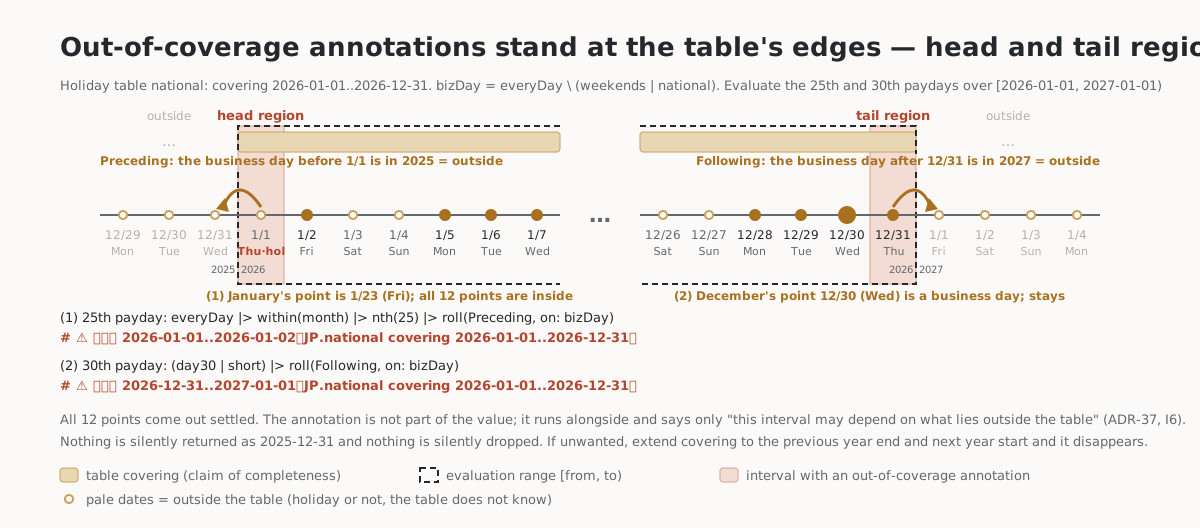
| roll | the image of the input annotations ∪ the dependency image of the axis’s annotated intervals (extended against the convention’s direction to the nearest known axis point before/after). Axis exhaustion is empty + annotation; but under a completed coverage (open end), an unannotated empty |
| selectors | if the target window intersects an annotation, widened to the whole window. The final window closed at the coverage edge (its end undetermined) counts as touching the annotation that starts at the coverage edge at the stages that read the end (last; nth with too few elements in the known part; first/nth on an empty known part) and is widened likewise — stages that read the start or membership are unchanged (ADR-37 revision 6) |
| stride/strideBy | if the walk intersects, everything from the first intersection onward (phase contamination) |
| take | the stride row’s isomorph plus a reduction: once the nth point settles before any intersection, annotation intervals beginning after the settlement are not transported (the output depends only on the input’s first n points — required for consistency with “after n, a legitimate empty with no annotation”. ADR-49) |
| takeLast | take’s mirror image: if the backward count intersects an annotation interval, everything on the past side from the intersection point (head-widening (-∞, …]) — plus a conditional reduction: only when the backward count settles the nth point (the past end) without intersecting, annotation intervals that complete further in the past are not transported (the output depends only on the input in [nth point, until]. ADR-52 decision 4) |
| segmentBy | the complement of the marker coverage. edges:/empties: fire at the coverage edges (not the sequence edges) — within the coverage, even the window starting at the final marker is determined up to the coverage edge (= the window sequence’s effective coverage). Stretches where no window is laid (the head side under edges: drop/error; gaps under empties: drop) are out-of-coverage for the window sequence = annotated (ADR-37 revision 3). The end of the final window is undetermined — the true window may continue past the coverage edge (how end-reading stages treat it: the selectors row and the witness rule in §4.9; the point set is unchanged, only annotations grow. ADR-37 revision 6) |
| filter | points that demanded an out-of-coverage reference are dropped, and the annotation widens to the preimage of the region (window) the predicate read (ADR-37 revision 2 = F75; for predicates reading only d’s neighborhood, as before: the dependency’s annotated intervals ∩ the evaluation region) |
| generators, within, snapTo | pass the input’s annotations through (point transforms, via the image). A calendar-system-pure generator itself produces no annotations |
| rebase | inflate the endpoints to the source’s day windows by floor/ceil, then map by label correspondence (over-approximation allowed; ADR-40) |
The table’s images laid out on one chart — an input S depending on a gap in the covering
〔2027-01-20, 2027-05-10〕 (the out-of-coverage annotation stands on that interval), passed through
each operator over the evaluation range [2026-07-01, 2028-01-01); shown are the output’s annotated
intervals. shift is shift(+1, unit: month); the selector and the filter read month windows
(first(of: month), a coincides-class predicate). The combinators’ union and roll’s dependency
image are as in the table:
gantt
    dateFormat YYYY-MM-DD
    axisFormat %Y-%m
    title Images of transport — how the same input annotation maps per operator
    section Input S
    annotated interval = gap in the covering :crit, 2027-01-20, 2027-05-10
    section shift
    input ∪ translated image (+1 month) :crit, 2027-01-20, 2027-06-10
    section Selector
    widened to whole intersected windows (Jan to May) :crit, 2027-01-01, 2027-06-01
    section stride
    everything from the first intersection = phase contamination (surface clipped to evaluation range) :crit, 2027-01-20, 2028-01-01
    section filter
    widened to preimage of the windows the predicate read (F75) :crit, 2027-01-01, 2027-06-01
The point: only stride fails to close on the right (even when the data returns past the gap, the walk’s phase is already contaminated). The selector’s and the filter’s images coincide because in this example both read the same month windows.
Cancellation under composition is done only by an explicit coverage claim (the binding postfix
covering:; §3.8). Premise bindings acquire their annotations per evaluation, not at
definition (nothing is baked into the definition).
The error classifier: a failed reference (a point absent from the column in table projection; no window membership; no landing point for roll/shift; parallel-list indexing) is classified “out-of-coverage” when the failing point lies outside the effective coverage of the binding that the reference actually reads (in stream context, drop and annotate; in pure-value context, an explicit error classified out-of-coverage); inside it, a hard error as before (mix-ups stay under ADR-16’s governance). Multi-dependency cases are classified by the failed reference’s dependency alone; when both stories would explain it, err on the safe side = hard error.
The vessels are two (the implementation surface of “judgment is external”; the canonical form is the reference implementation): (a) interval annotations — clipped to the evaluation range [from, to) and returned on equal footing with the result (clipping happens once, at the surface; internal propagation is unclipped). (b) the coverage summary — for each data source referenced, returns 〔source, covering, asof, completion claim, runway from the evaluation’s to〕 without clipping (watching for “the data runs out right after to”; making completion claims observable). The response — fail, warn, or proceed — is the caller’s responsibility (ADR-15).
The two horizons: do not confuse the data coverage (covering:, the source of annotations) with the evaluation range (from/to, the clipping frame of annotations). A narrow evaluation fitting inside the coverage runs with zero annotations (“do not kill narrow evaluation ranges”). An implementation’s materialization range is a third, approximate horizon absent from the language (crossing it is clipping plus an implementation warning — neither an annotation nor a hard error). The three overlap but are distinct — different owners, different consequences of crossing:
gantt
    dateFormat YYYY-MM-DD
    axisFormat %Y-%m
    title The three horizons — overlapping but distinct
    section Data horizon (the supplier)
    covering — depending outside it yields out-of-coverage annotations :done, 2026-01-01, 2026-12-31
    section Evaluation horizon (the caller)
    from..to — outside is merely unobserved :active, 2026-07-01, 2027-06-30
    section Implementation horizon (outside the language)
    materialization range — crossing clips with an implementation warning : 2025-09-01, 2027-12-31