 Kairos
| English | 日本語版 README(ドキュメントは日本語が正) |
The Japanese documentation is canonical; the spec, the descriptor reference, and the stdlib guides are fully mirrored in English under
en/(every page links its counterpart).llms.txtcarries the machine-readable overview. Requests and issues in English are welcome — open an issue.
Kairos is a schedule definition language — a small, composable DSL that defines when things should happen. It goes beyond cron-style patterns: schedules like “3 business days before month-end”, “the first business day on or after February 1”, or dates derived from the lunisolar calendar are all first-class expressions.
premise US { calendar-system: Gregorian; tz: "America/New_York"; wkst: Sun }

@US
federal2026 = [2026-01-01, 2026-01-19, 2026-02-16, 2026-05-25, 2026-06-19, 2026-07-03,
               2026-09-07, 2026-10-12, 2026-11-11, 2026-11-26, 2026-12-25] covering: 2026..2026
bizDay = everyDay \ ((everyDay |> filter(d => weekday(d) == Sat or weekday(d) == Sun)) | federal2026)
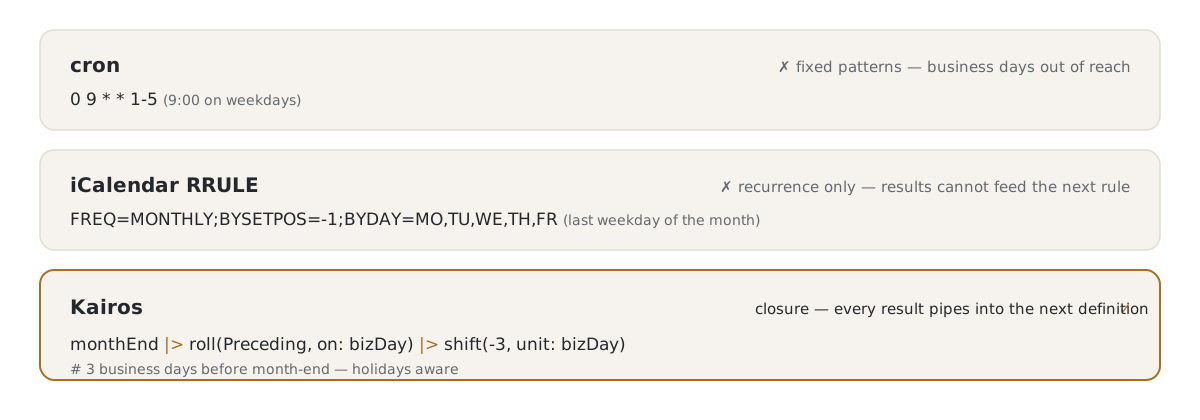
monthEnd |> roll(Preceding, on: bizDay) |> shift(-3, unit: bizDay)   # 3 business days before month-end
cron and iCalendar RRULE can express “N calendar days before month-end”, but no existing schedule language lets you write “the Nth business day” inside an expression. The root limitation is not a missing feature — their expressions do not compose: you cannot take the dates one rule derives and feed them into the next rule. Kairos is built around this closure property (every expression is a transformation from a time stream to a time stream), so substitute-holiday derivation, fiscal calendars, the Japanese lunisolar calendar, and the 24 solar terms are all written with the same small operator family.
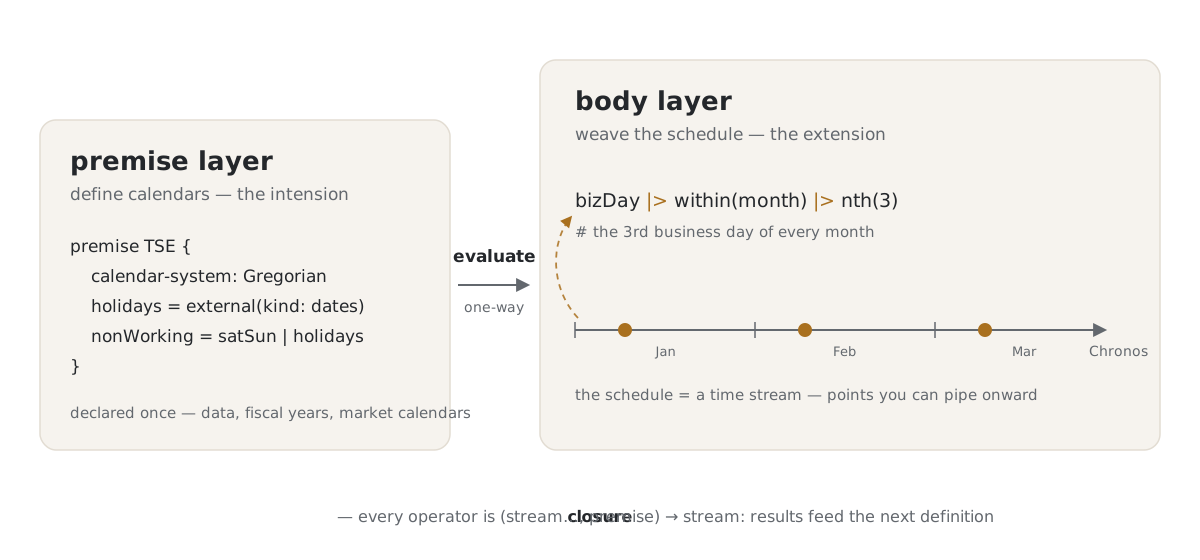
Highlights
- Business-day arithmetic in the language —
roll(Preceding, on: bizDay),shift(-3, unit: bizDay); not a “skip / shift” flag bolted onto an external calendar object. - Calendars are user-definable — the Gregorian calendar itself is a transparent standard library
written in Kairos (
stdlib/); fiscal years, ISO weeks, and the Japanese lunisolar calendar (kyūreki) are ordinary definitions, not built-ins. - Deriving, not enumerating — Japan’s substitute holidays and “citizens’ holidays” are derived by rule from the statutory holiday table alone; the rokuyō (六曜) cycle is derived from lunar months.
- Deterministic and auditable — a definition denotes a set of instants. Missed fires during downtime are enumerable; evaluation is reproducible.
- Staleness is observable — when calendar data runs out, results carry machine-readable annotations
(
covering) instead of silently degrading. - Mistake-proofing as static checks — timezone, granularity, and alignment mismatches, and missing declarations (week start, roll convention, calendar) are errors, not silent misfires.
What an error looks like
Every diagnostic has three parts: operator: what is wrong(how to fix it. where the rule lives). The text
is Japanese (the canonical language); the trailing reference (I3, ADR-38, §3.3) is the spec’s own numbering
and can be looked up in the English mirror. Three real ones from the reference CLI 1.0.5:
roll は規約が必要(I3)——位置引数で Following/Preceding を書くか前文で roll: を宣言— “roll: a convention is required (I3) — write Following/Preceding as the positional argument, or declare roll: in the premise”. Fix:roll(Preceding, on: bizDay), or once in the preamble,@JP roll: Preceding.strideBy: 幅は正の量(0 幅は前進しない=無限ループ。1s・1d のような正の幅を書く。ADR-38 判断 12)— “strideBy: the width must be positive (a zero width never advances = an infinite loop; write a positive width such as 1s or 1d. ADR-38 decision 12)”. Fix:strideBy(1d, from: 2026-01-01).stride: n は 1 以上の整数(0 は不可。ADR-38 判断 12)— “stride: n is an integer of 1 or more (0 is not allowed. ADR-38 decision 12)”. It does not become a silent empty stream. Fix:stride(2, from: 2026-01-05).
The CLI prints the message and exits with code 1; no result is emitted.
Comparison with cron, Quartz, and RRULE
✓ = expressible in the language/definition · △ = partial (hacks, add-ons, implementation-specific) · ✗ = not expressible. “BDC products” = business schedulers with a business-day-calendar object plus shift flags. Full version with section pointers: spec §1.2.
| Capability | cron | Quartz | RRULE | BDC products | Kairos |
|---|---|---|---|---|---|
| Fixed-time recurrence (daily at 9:00) | ✓ | ✓ | ✓ | ✓ | ✓ |
| Nth weekday (2nd Monday) | △ (day/weekday OR trap) | ✓ (#) |
✓ (BYDAY + BYSETPOS) | ✓ | ✓ (nth) |
| Month-end / N calendar days before it | ✗ (28–31 hack) | ✓ (L) |
✓ (BYMONTHDAY=-1) | ✓ | ✓ (month |> last |> shift) |
| Business days (holiday-aware) | ✗ | △ (exclusion = skip only) | ✗ (static EXDATE) | ✓ | ✓ (calendar entity + derived bizDay) |
| Business-day arithmetic (Nth business day) | ✗ | ✗ | ✗ | △ (shift flags only) | ✓ (roll / shift(unit: bizDay)) |
| Deriving holidays by rule (substitute holidays) | ✗ | ✗ | ✗ | ✗ (enumeration only) | ✓ (cascade) |
| User-defined calendars (fiscal, ISO week, lunisolar, solar terms) | ✗ | ✗ | △ (RFC 7529, rarely implemented) | △ (internal rules only; degrade to expanded lists across the API boundary) | ✓ (premise layer) |
| Composition / closure (derived dates feed the next rule) | ✗ | ✗ | △ (RDATE/EXDATE only) | ✗ | ✓ (stream → stream) |
| Cross-timezone composition (Tokyo × NY joint business days) | ✗ | ✗ | ✗ | ✗ | ✓ (rebase + alignment checks) |
| DST semantics | △ (implementation-defined) | △ | ✓ (wall clock) | △ | ✓ (declared; gaps/overlaps are explicit errors) |
| Detecting stale calendar data | ✗ | ✗ | ✗ | ✗ | ✓ (covering + out-of-coverage annotations) |
| Determinism / audit (definition = set of instants) | ✗ (depends on current time) | ✗ | ✓ | △ | ✓ (missed fires enumerable) |
| Static checks against silent mistakes | ✗ | ✗ | ✗ | ✗ | ✓ (alignment, granularity, tz, mandatory declarations) |
What Kairos deliberately does not do: firing, retries, and execution management (the host runtime’s
job — the language stops at defining the set of instants); feedback on execution state (“every 5 hours
since the last completion” as one infinite stream — instead, computing the next fire from an injected
instant is in scope and pure, see spec §7.7); guaranteeing the authenticity
of calendar data (provenance source: / asof: carries the evidence; the judgment is external);
branching on runtime conditions. (Count-based termination — RRULE COUNT — was on this list until
ADR-49: it is now covered by take(n, from:).)
Runtime integration — how a scheduler consumes Kairos
Kairos deliberately stops at defining the set of instants. Your scheduler (the “firing layer”) owns timers, retries, and state, and the division of labor is one simple loop — evaluate over a rolling horizon, register timers, repeat:
sequenceDiagram
    participant R as Runtime (firing layer / out of scope)
    participant K as Kairos (pure evaluation)
    loop Rolling horizon
        R->>K: evaluate definition over [from, to)
        K-->>R: list of instants (+ coverage annotations)
        R->>R: register timers → fire … (re-evaluate as "to" nears)
    end
    Note over R,K: every evaluation is a pure function<br/>overlapping ranges always agree (deterministic, auditable)
- Determinism — the same definition, range, and data always yield the same instants; advancing the horizon never changes the overlap. Restarts, replays, and audits are safe.
- Missed fires — evaluate over the downtime window [down, up) and you get exactly the instants that should have fired, as a plain list.
- Operational signal — instants beyond the calendar data’s coverage carry machine-readable annotations (“your holiday data needs updating”), instead of silently degrading.
Feedback schedules (“every 5 hours since the last completion”) are not a single infinite stream — that would feed outputs back into the expression. Instead the runtime injects the last completion time as data (exactly like a holiday table), and Kairos computes the next fire as a pure function of it:
@US
lastCompleted = [2026-07-09T14:23] covering: ..     # injected by the runtime (with source:/asof:)
lastCompleted |> snapTo(day) |> roll(Following, on: bizDay) |> shift(+3, unit: bizDay)
#=> 2026-07-14   ("3 business days after the last completion")
Full explanation with sequence diagrams and runnable doctests: spec §7.7–7.8; the full worked study is design/40-examples/07 (Japanese). The conformance profile for firing layers — what a Kairos-compatible runtime must satisfy (re-evaluation, at-least-once with idempotency keys, wiring of operational signals) — is spec appendix A (Japanese).
Quick start (reference implementation)
Try it in your browser first: the Playground runs the reference implementation as-is — no install, nothing leaves your browser.
Install from npm (Node.js 20+; zero runtime dependencies):
npm i -g kairos-lang                             # or without installing: npx kairos-lang --version
kairos list impl/examples/payday.kairos --from 2026-01-01 --to 2027-01-01
kairos next -n 3 --json impl/examples/payday.kairos   # next 3 firings from today, machine-readable
(impl/examples/ lives in this repository; the npm package ships the CLI and the stdlib. The block below runs
the TypeScript source directly, for development.)
Runs TypeScript directly with Node.js 24+; zero runtime dependencies.
cd impl
npm install          # devDependencies only (typescript / vitest)
npm test             # spec examples, real-ephemeris cross-checks, doctests

node src/cli.ts list examples/payday.kairos      --from 2026-01-01 --to 2027-01-01
node src/cli.ts list examples/jp-holidays.kairos --from 2026-01-01 --to 2027-01-01
node src/cli.ts list examples/rokuyo.kairos      --from 2026-01-01 --to 2027-01-01
node src/cli.ts next -n 3 examples/payday.kairos   # next 3 firings from today (--json for machines)
--lang en switches the human-readable framing (headings, coverage summary, usage) to English;
evaluator messages stay in Japanese — the implementation’s canonical output — and --json is
language-neutral.
jp-holidays.kairos derives Japan’s substitute holidays and citizens’ holidays from the statutory
holiday table alone. rokuyo.kairos derives the rokuyō cycle (大安 and friends) from the lunisolar
calendar, cut by the National Astronomical Observatory of Japan’s new-moon data.
Limits (what it does not do)
- Calendar model: the proleptic Gregorian calendar as an idealisation (the leap-year rule is applied to every year; the 1582 reform is not modelled). Other calendars are built on top of it in the premise layer (spec §3.6).
- No leap seconds: the base axis (chronos) is uniform;
23:59:60is a lexical error (spec §5, ADR-33). - Years have four digits (0000–9999);
10000-01-01is a lexical error. - DST: civil widths (
1d) keep wall-clock time, so a civil day may be 23–25 hours; a time literal that falls into a DST gap or overlap is an error, not a guess (spec §3.6, §5; ADR-33, ADR-51). A civil width is a whole number of days (1.5dis an error; write36h). - Reference implementation only, not the language: the evaluation range starts at 1970-01-01 (an earlier
--fromis an explicit error); points are materialised up toto+ 400 days and ahorizon-clipwarning marks that edge; a point that a stage moves out of[from, to)is not in the output and gets awindow-clipwarning; there is no cap on the number of points — memory grows with the output, and the caller chooses the range (a service front end should bound the range; the language does not); the time resolution is 1 ms (a finer width or seconds fraction is a lexical error, not a silent rounding). - Out of scope: firing, retries, logging and job execution belong to the host (spec §7.8);
Modifiedroll conventions and the general composition ofeveryInstantare unimplemented (impl/README).
Status and documentation
Version 1.0 (declared 2026-09-14; addenda through no. 28, 2026-10-19). Semantics, the operator family, grammar (EBNF), and lexis are
frozen; naming is final for every word (the last placeholder shiftBoundary was settled as rephase on 2026-07-26). Expressiveness
is validated against 20 well-known schedule families and by a reference implementation (827 tests),
including cross-checks against the official ephemeris of the National Astronomical Observatory of Japan.
| Directory | Contents |
|---|---|
spec/ |
Language specification (reviewable snapshot; start here — 日本語) |
recipes/ |
Recipes — the schedules cron/Quartz/RRULE can’t express, one page per requirement with Playground links (日本語) |
reference/ |
Descriptor reference — one page per operator; examples are doctested (日本語) |
stdlib/ |
Standard premises: Gregorian, Fiscal, ISOWeek (日本語 — includes the Japanese-only Kyureki) |
impl/ |
Reference implementation (TypeScript, zero runtime deps; prototype — Japanese) |
mcp/ |
MCP server kairos-lang-mcp — evaluate (list/next), validate and look up the reference from an MCP client; tz is required (English) |
design/ |
Design records: 53 ADRs, domain model, expressiveness studies incl. the “impossible schedules” catalog (Japanese; catalog mirrored in English) |
MAINTENANCE.md |
Maintenance guide — the yearly holiday-table update, the freshness check, what a red CI means, how releases are published (Japanese, with an English summary). Policy: design/75-stewardship.md |
Study materials for the Kairos language exam — graded textbooks (reading, writing, operational semantics) and sample questions, every example executed against the reference implementation — live at exam.kairos-lang.org (Japanese).
License
Apache-2.0 (attribution in NOTICE). Contributions are accepted under Apache-2.0 §5
with a DCO sign-off (Signed-off-by: line). The “Kairos” name and
logo (assets/logo/) are excluded from the license (Apache-2.0 §6).