external — the external supply declaration (a table literal resolved at run time)
Translated from the canonical Japanese page reference/external.md. The
source_shaabove records the source revision; a consistency check flags this page when the Japanese original changes.
Category: declaration in a premise binding / Form:
name = external(kind: dates | instants [, labels: [domain]] [, source: "…"]) / settled (ADR-46)
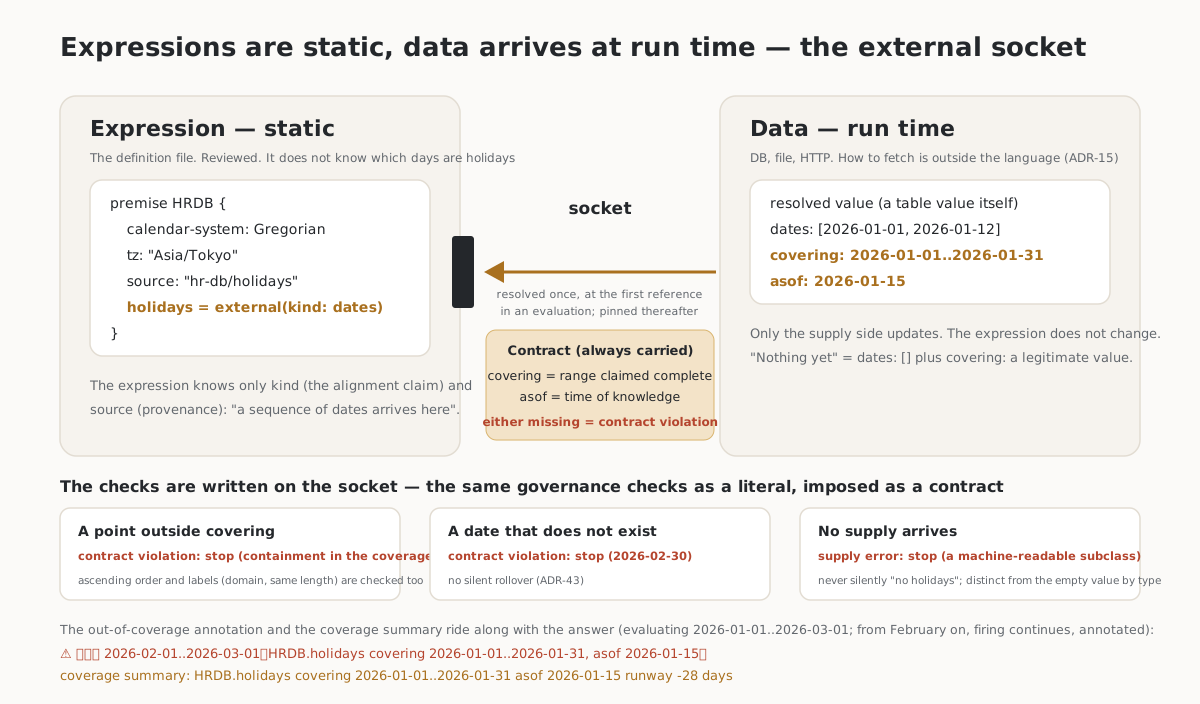
Meaning
The socket for “expressions are static, data resolves at run time”. The static properties that a table literal carries in its literal text are here claimed in advance by declaration, standing in for the missing text — the resolved value (point sequence, covering, asof, labels) is subject, as the supply contract, to the same governance checks as literals (containment in the coverage, ascending order, same length). No new type and no new algebra: the resolved value is a table value itself, and out-of-coverage annotations, the coverage summary, and the runway (spec §4.10) ride on it unchanged.
kind:— the alignment claim (mandatory).dates= a date sequence (aligned to the civil-day grid of the premise’stz:);instants= timed (no alignment). The alignment is decided statically from the declaration and does not depend on the resolved value’s row count or contents (even empty, it is as declared — going from 0 rows to 1 row never changes the outcome of the alignment check).labels:— the enumeration of the label value domain (optional). The declaration is static knowledge, so bare-name label comparison (filter(s => sekki(s) == 立春)) can be written. The resolved value’s labels must lie within the domain and match the instant sequence in length. With no declaration, no labels (if labels arrive anyway, that is a contract violation — they are not silently dropped).source:— provenance (mandatory: either the premise membersource:or a per-binding named-arg override).- covering and asof are always carried by the resolved value (absence of either = contract
violation). “Nothing at all yet” is
dates: []plus covering (the empty-table equivalent) = a legitimate value; a failure to resolve = a supply error (a machine-readable subclass — an implementation can exclude it from boot checks and fall back to degraded operation). The two are distinguished by type. - Resolution is an adjunct of the evaluation context (an “input to the evaluation”, like tz, wkst, and asof) — resolved only once, at the first reference within the evaluation, and pinned to that snapshot thereafter (never resolved if never referenced). The means of acquisition (DB, file, HTTP) is outside the language (ADR-15).
Examples
Receiving a holiday table by external supply (the # resolve: line is the doctest’s resolver
fixture — in production the implementation plugs in the resolver):
# eval: 2026-01-01..2026-03-01
# resolve: holidays = dates 2026-01-01 2026-01-12 covering: 2026-01-01..2026-01-31 asof: 2026-01-15
premise HRDB { calendar-system: Gregorian; tz: "Asia/Tokyo"; wkst: Mon; source: "hr-db/holidays"
  holidays = external(kind: dates)
}
@HRDB
holidays
#=> 2026-01-01 2026-01-12
#~> 範囲外 2026-02-01..2026-03-01(HRDB.holidays covering 2026-01-01..2026-01-31, asof 2026-01-15)
The region outside the coverage (February onward) becomes an out-of-coverage annotation, and the coverage summary raises source, covering, asof, and runway — securing lead time for data updates (an operational signal for the firing layer) is observed in the same vessel as for literals.
Pitfalls
- Only as the right-hand side (its head) of a premise binding — the body layer, top-level
bindings under a preamble, lambda interiors, and argument positions are static errors (the
governance of
source:/tz:must live on the premise). Compose in the formexternal(…) |> snapTo(day). - A premise with external must declare
tz:— the ends of the covering and the anchor ofkind: datesresolve in the definition side’s tz (an extension of ADR-37 decision 1). - The resolved value’s dates are checked for existence (
2026-02-30is a contract violation) — a re-run, against resolved values, of the literal lexical checks (ADR-43). Silent rollover does not happen here either. - A disagreement between the premise’s static
asof:(the edition pin) and the resolved value’s asof is displayed permanently in the coverage summary — no silent overwrite. Preserving snapshots for reproduction and audit is the implementation’s responsibility (under the generation approach the generating source itself was the evidence — the bearer moves). - Responsibilities that stay on the supply side: keeping the point sequence ascending; the truthfulness of covering (“was that range really fetched exhaustively?” cannot be checked); the correctness of asof. What the language imposes stops at the checks (the face that makes absences and violations loud).
- The wire format is per kind —
datesis the lexical form of dates ("YYYY-MM-DD"; the language side does the anchoring, so a derivation’stz:override can re-anchor), andinstantsis epoch ms (because a wall-clock lexical form can be two-valued under a DST overlap).
Related
table-literal (the same vessel written in literal text; the empty table),
provenance governance (spec §3.8), alignment (spec §4.5), ADR-45/46.