Table literal — a stream constant of an instant sequence
Translated from the canonical Japanese page reference/table-literal.md. The
source_shaabove records the source revision; a consistency check flags this page when the Japanese original changes.
Category: literal (the premise layer is its main ground) / Form:
[instant, …] covering: range labels: [label, …]; empty form [] covering: range (ADR-45) /
covering: and labels: settled (RC2, spec §5.4)
Meaning
A list of instant literals is promoted to a time-stream constant (ADR-26). The intake that brings into a premise, as data, the sequences that cannot be generated from periodic rules — the gazette-proclaimed vernal and autumnal equinoxes, new moons, the twenty-four solar terms, year-limited special days.
- The sequence must be ascending (out of order or duplicates are static errors).
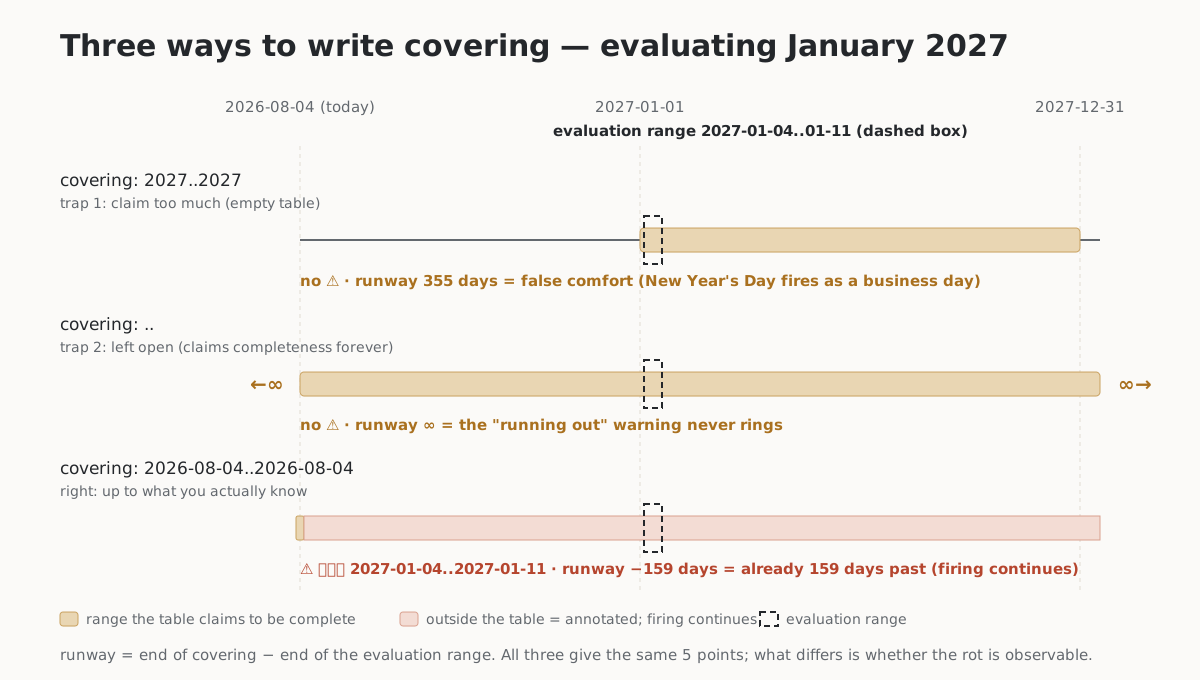
covering:— the effective range. Evaluation outside the range flows into the evaluation annotations as an out-of-coverage provenance, distinguished from an “accidental empty” (I6). When omitted, the range is the ends of the sequence. The ends are inclusive on both sides — ina..b,bruns to the end of that civil day (..2027-01-01includes 1/1 = the exclusive end is 00:00 on 1/2), and the year shorthand2026..2026is the whole year (ADR-37 decisions 1/9. “..2027-01-01stops just short of 1/1” is a misreading — a step actually measured in the firing layer’s implementation feedback).- The empty table
[] covering: range(ADR-45) — the primary form of “zero points, but the coverage is to be claimed”. The vessel for writing the supply layer’s “nothing at all yet” (first boot, year rollover) as a legal source; the coverage summary raises the runway (immediately negative) as an operational signal. The empty form makescovering:explicitly mandatory (the omission default “the ends of the sequence” is undefinable on an empty sequence);labels:is legal only as[]; the alignment is vacuous conformance (conforms to every alignment and passes the checks; in combination it inherits the partner. spec §4.5). labels:— a parallel label sequence of the same length as the instant sequence. It defines a point→label projection, and the binding name is itself the projection name (sekki(d). ADR-30).- The range literal
a..bis sugar expanding to an enumeration of consecutive days. - A premise containing a table is
source:(provenance) declaration-required leaning; the edition is carried byasof:(provenance governance).
Examples
Mixing with the date-range sugar:
# eval: 2026-01-01..2027-01-01
@JP
[2026-02-10..2026-02-13, 2026-03-01]
#=> 2026-02-10 2026-02-11 2026-02-12 2026-02-13 2026-03-01
#~> 範囲外 2026-01-01..2026-02-10((無名テーブル) covering 2026-02-10..2026-03-01)
#~> 範囲外 2026-03-01..2027-01-01((無名テーブル) covering 2026-02-10..2026-03-01)
A labeled table — selecting 立春 (the “start of spring” solar term) by name (a table of instants alone can select only by ordinal. F33):
# eval: 2026-01-01..2026-03-01
@JP
sekki = [2026-01-05T17:23, 2026-01-20T10:45, 2026-02-04T05:02]
  covering: 2026..2026
  labels: [小寒, 大寒, 立春]
sekki |> filter(s => sekki(s) == 立春) |> snapTo(day)
#=> 2026-02-04
The empty table — writing “nothing at all yet” with the claim attached (zero points; the coverage is only the observation day itself. The out-of-coverage annotations and the coverage summary’s runway (immediately negative) become the operational signal “put the data in”. ADR-45):
# eval: 2026-07-01..2026-08-01
@JP
sekki = [] covering: 2026-07-13..2026-07-13
sekki
#~> 範囲外 2026-07-01..2026-07-13(sekki covering 2026-07-13..2026-07-13)
#~> 範囲外 2026-07-14..2026-08-01(sekki covering 2026-07-13..2026-07-13)
Pitfalls
- The postfixes come in either order —
covering:andlabels:mean the same whichever comes first (once each; a duplicate is a static error. RC5 addendum 9. The old implementation silently discarded acovering:written afterlabels:— unchecked acceptance that let the coverage fall back to the default 〈the sequence ends〉 = F104; detected and sealed via the alerting-layer feedback, 5th delivery). - A calendar system that carves windows with data (a lunisolar calendar cut at new moons) is the
same premise type — what calendar-system purity (I8) forbids is a generator’s dependence on a
calendar (business-day policy), not a calendar system’s dependence on data. The purity
distinction is drawn by provenance (
source:/asof:) (ADR-26). labels:attaches not only to points (tables) but also to window sequences (segmentBy) (ADR-39) — data labels on points (this page), data labels on windows (segmentBy’slabels:; same-length is checked as window count = marker count), and computed labels on windows (thelabel:lambda = ADR-34) are a symmetric three-source family, read uniformly asbindingName(d).labels:is a one-to-one attachment to finite data. For an infinite rhythm, usecycle. Only the source differs; the reading side is binding-name projection either way.- A table (a point sequence) has no value-argument application — when tempted to write
sekki(立春), the filter is canonical (sekki |> filter(s => sekki(s) == 立春)— the carrier’s point sequence is at hand, so one line suffices. ADR-42 decision 5). Value arguments stand only on window bindings (segmentBywithlabels:; window words withlabel:), and those return “the days of the period of the windows with that label” (window-instance reference). - Automating the supply (the socket for external data) is written with
external(ADR-46 = a table literal resolved at run time). The division of use: a literal is “data embedded in the expression”, external is “data received in the vessel” (resolving what ADR-26 had deferred). - A single-element table = the vessel for “a given instant” (
[2026-07-09T14:23] covering: ..). Next-fire computations such as “3 business days after an injected instant” can be written with this vessel plussnapTo/roll/shift(of execution-origin relativity, only the feedback loop is out of scope — spec §7.7). Its dual is the empty table = the vessel for “not yet” (the example above). - The empty table’s alignment changes once rows arrive (vacuous conformance → the civil-day
grid if the lexis is date-only, “none” if timed — a consequence of alignment being read from the
literal text. A limit noted explicitly in ADR-45). If a vessel that will grow into a timed
sequence is used in
&/\compositions, inserting an explicit realignment (snapTo) keeps the checks from breaking on the first data arrival. - Writing the empty table open-ended (
[] covering: ..) is a completeness claim of “empty over all time”, and the runway signal disappears permanently — the proper form for a boot-time “not yet” is a closed end (an honest minimal claim, such as the observation day itself).
Related
segmentBy (cutting windows with data), snapTo,
cycle, provenance governance (spec §3.8), ADR-26/30.