grid — uniform division of the continuous axis (the atoms of a calendar)
Translated from the canonical Japanese page reference/grid.md. The
source_shaabove records the source revision; a consistency check flags this page when the Japanese original changes.
Category: window-generating word (premise layer) / Signature:
grid(w) : Chronos -> Stream(partitioned) / name settled (spec §5.4)
Meaning
Tiles the continuous base Chronos uniformly at width w, making the atoms of a calendar. The
only word in the language that accepts chronos (the base’s lexical name. ADR-29). Its main
writers are calendar-system definers (Gregorian’s day stands on it), but the form in which a
calendar entity lays the wall-clock ticks of business hours
(nine = chronos grid 1d anchor: …T09:00; ADR-41) is a legitimate second use.
The width w follows the civil-time width conventions (ADR-11/12) — 1d is “1 civil day”,
not a fixed 86400s. The civil day of a DST transition is 23–25 hours long (leap seconds are out
of scope = ADR-33).
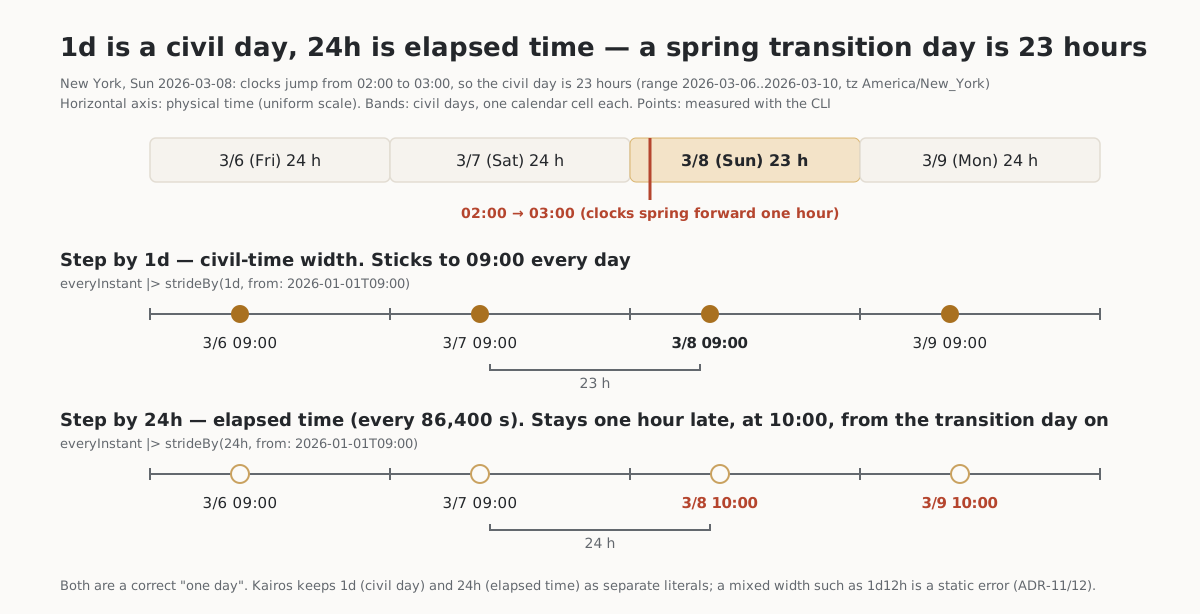
The phase aligns by default (ADR-31): civil-time widths (d) to the opening instant of each
civil day in the in-scope tz: (midnight on ordinary days. ADR-31 revision); elapsed-time widths
(h/m/s) to the epoch. That day = chronos grid 1d becomes “calendar days cut at
midnight” with nothing specified is due to this default. Override with anchor: only when a
different phase is needed. For a civil-width grid with a timed anchor, the window boundaries
are “the first instant in each civil day at which the anchor’s wall-clock time (a label reading)
is read” (a DST gap → the first instant after the gap; an overlap → the first occurrence; a
nonexistent civil day → no tick; an anchor placed at a civil day’s opening point → day alignment.
ADR-31 revision 2) — anchor: 2026-01-01T09:00 keeps wall-clock 09:00 even on DST transition days.
Examples
Laying ten-day “dekad” (旬) windows from a 2026-01-01 origin:
# eval: 2026-01-01..2026-02-05
premise Dekad = Gregorian with { decade = chronos grid 10d anchor: 2026-01-01 }
premise JPD { calendar-system: Dekad; tz: "Asia/Tokyo"; wkst: Mon }
@JPD
everyDay |> within(decade) |> first
#=> 2026-01-01 2026-01-11 2026-01-21 2026-01-31
The standard definition of day (stdlib/gregorian.md):
day = chronos grid 1d # the atom. Phase is the default (each civil day's opening instant = midnight on ordinary days), so no anchor: needed
label: (ADR-34)
grid also takes a postfixed label: (p => expr) (p = the window’s first point; details in the
same section of span and ADR-34).
Pitfalls
- Only
chronoscan be passed togrid— dividing an existing window issplit(with a variable-width list), orspanup from finer atoms. - Never build the calendar “month” as
grid(30d)— months are non-uniform, so bundle them withspan daysInMonth(variable aggregation by a value expression).
Related
span · split · cycle · chronos (ADR-29) · phase and the
epoch (ADR-31) · ADR-11/12.