cycle — parallel repeating labels (labels, not windows)
Translated from the canonical Japanese page reference/cycle.md. The
source_shaabove records the source revision; a consistency check flags this page when the Japanese original changes.
Category: window-generating word (premise layer) / Signature:
cycle(labels) anchor: r : Stream -> Stream(labeled) / name settled (spec §5.4)
Meaning
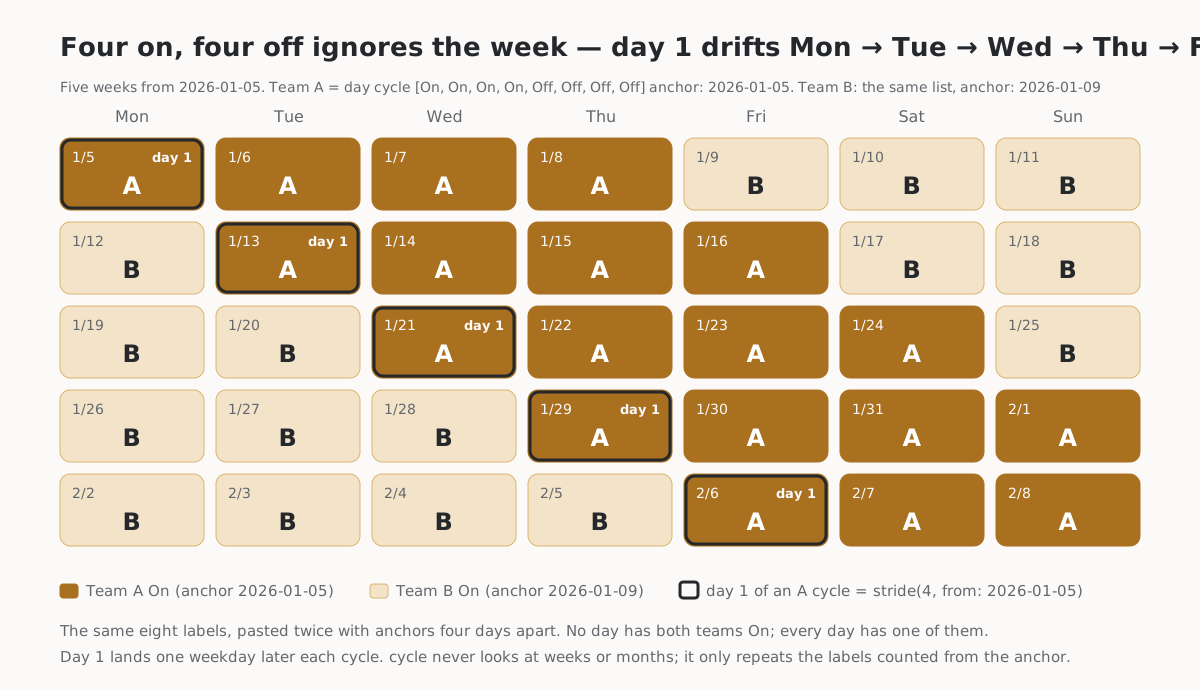
Attaches repeating labels to a target partition window. It creates no windows — just as
weekdays do not partition the days, labels are a concept parallel to windows (ADR-03). The
period length is arbitrary (7, 10, 12, 60, …), and so is the target window (not only weekdays over
day — it can be laid over month and year too; the twelve earthly branches are
year cycle […]).
- The list gives only the cyclic order; the head carries no meaning of “start” (where the week starts is WKST’s job. stdlib/gregorian.md §4.1).
anchor:is the actual day that pins the phase — “the target window containing the anchor carries the head label”.- The binding name reads as a value-expression “point → label” function —
weekday(d),yearBranch(d). Resolution is the two steps point → containing window → label (ADR-27/30).
Examples
The yearly earthly branches — with 2020 (子, the Rat) as anchor, selecting New Year’s Day of a 午 (Horse) year:
# eval: 2020-01-01..2028-01-01
premise JPEto = Gregorian with {
  tz: "Asia/Tokyo"                  # needed to anchor the date literal in anchor: (ADR-33)
  yearBranch = year cycle [子, 丑, 寅, 卯, 辰, 巳, 午, 未, 申, 酉, 戌, 亥] anchor: 2020-01-01
}
@JPEto
everyDay |> within(year) |> first |> filter(d => yearBranch(d) == 午)
#=> 2026-01-01
Reading the standard weekday (Gregorian.weekday) in a predicate:
# eval: 2026-01-01..2026-01-20
@JP
everyDay |> filter(d => weekday(d) == Mon)
#=> 2026-01-05 2026-01-12 2026-01-19
Pitfalls
cycleis a rhythm (calendar-system-pure, infinite) — a 1-to-1 label over finite data, like the names of the 24 solar terms, is not a cycle but a table’slabels:(table literal; the source differs, but the reading side is the same binding-name projection). Attaching a fixed period to a data-derived window sequence issegmentBy’slabels: cycleform (ADR-47 — the same “the window containing the anchor carries the first label” as this page).- Rotating the list (rewriting
[Mon, …, Sun]as[Sun, Mon, …], etc.) gives the same calendar only if the anchor is also re-taken to a corresponding real day — with the anchor fixed, every label rotates at once (the phase is decided by “the window containing the anchor = the first label”. The old wording “the same anchor gives the same calendar” was wrong — corrected 2026-07-25). That the list order has nothing to do with the week’s start (WKST) still holds. - Choosing the anchor (practical guidance; runtime-side reflux, 2026-08): as a rule, write a verified real day as the anchor, as-is. Whether verification is needed splits by the anchor’s nature — observation-verified anchors (day stems-and-branches, the 28 lunar mansions: which real day carries which label can only be settled by checking primary sources and printed almanacs) versus convention-defined anchors (like the solar-term month’s “the window of Risshun is the Tiger month”, where the definition itself gives the phase — no verification needed). When the traditional list order disagrees with the verified real day’s phase, keep the verified day fixed and rotate the list side (the flip side of the item above — “rotation comes paired with re-taking the anchor”, applied by choosing to pin the verified value).
- A composite period like the 60-term sexagenary cycle may be a single 60-element cycle, or the two cycles of the ten heavenly stems and the twelve earthly branches composed in a predicate (a zip product of cycles is not introduced — open item F16).
Related
filter (label predicates) · table literal (data-derived labels) ·
the separation from WKST (stdlib/gregorian.md §4) · ADR-03/27/30.