roll — nudge invalid points to valid ones
Translated from the canonical Japanese page reference/roll.md. The
source_shaabove records the source revision; a consistency check flags this page when the Japanese original changes.
Category: point transform (body-layer core) / Signature:
roll(conv, on: P) : Stream -> Stream / name settled (spec §5.4)
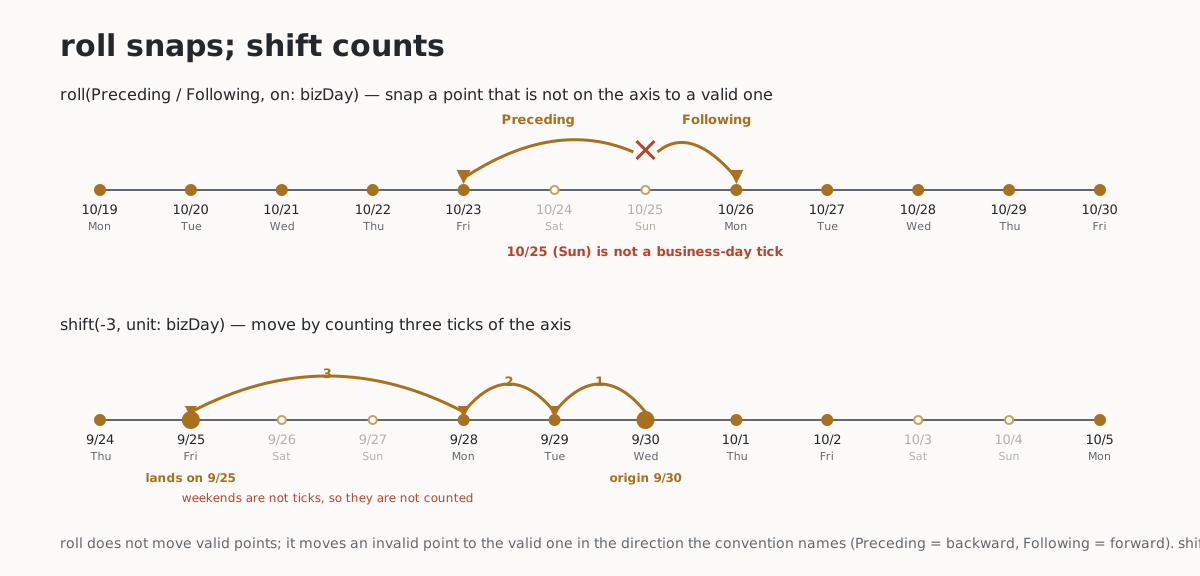
Meaning
If a point is not a valid point on axis P, it is nudged to a valid point according to the
convention conv. Valid points do not move. The operator at the core of “if a holiday, the
preceding business day” and “a holiday falling on Sunday substitutes to the next weekday”.
Roll conventions are axis-independent (ADR-13) — the same system rides on business days and on DST alike. The convention and the axis are mandatory arguments (I3: an operator that can land on an invalid or absent point takes its resolution as a mandatory argument and never chooses silently by default).
| Convention | Meaning |
|---|---|
Following |
to the next valid point |
Preceding |
to the previous valid point |
Modified |
takes an enclosing window as an argument and nudges while staying within that window (if it would cross the month, go to the opposite side. ADR-14) |
on: accepts, besides axis names, a derived stream passed as-is (ADR-26) — this becomes the
key to substitute holidays.
Examples
Payday: the 25th of every month, or if a holiday the preceding business day (2026-01-25 is a Sunday → Friday 1/23):
# eval: 2026-01-01..2026-02-01
@JP
everyDay |> within(month) |> nth(25) |> roll(Preceding, on: bizDay)
#=> 2026-01-23
#~> 範囲外 2026-01-01..2026-01-02(holidays2026 covering 2026-01-01..2026-12-31, asof 2026-01-05)
Substitute holidays: nudge Sunday holidays forward on the derived axis “days that are not holidays”. It automatically leaps over the holiday run (5/4 and 5/5 are also holidays) and lands on 5/6:
# eval: 2026-05-01..2026-06-01
@JP
statutory   = [2026-05-03, 2026-05-04, 2026-05-05] covering: 2026..2026
nonHoliday  = everyDay \ statutory
statutory |> filter(d => weekday(d) == Sun) |> roll(Following, on: nonHoliday)
#=> 2026-05-06
Anonymous axes (inline stream expressions) are accepted as well — a named-arg takes a stream-expr (spec §5.6), and a derived stream has the same type as an axis (F7, ADR-26). “The last Friday of the month” can be written without naming anything (a “good discovery” from the implementation feedback’s third batch, spelled out here as a guarantee):
# eval: 2026-01-01..2026-03-01
@JP
month |> last |> roll(Preceding, on: (everyDay |> filter(d => weekday(d) == Fri)))
#=> 2026-01-30 2026-02-27
Pitfalls
rollnever thins points (each point → one point). Thinning isfilter’s job.- When several points nudge onto the same valid point, the duplicates fold (a stream is a set of points).
- If the axis is folded into the preamble,
on:may be omitted (roll(Preceding)under@JP axis: bizDay. spec §3.3). The roll convention itself, however, is always written explicitly. - Input and axis must agree in alignment (ADR-36, spec §4.5) — nudging a timed point sequence
onto a daily axis is a static error (first conform explicitly with
snapTo(day)). A calendar entity name may also stand directly aton:(on: TSE) (reinterpreted as the standard derivation. ADR-35). -
Beware short axes — passing
on:a window-instance reference (on: year(2020)-class, ADR-42) or a table with a short covering makes the axis bounded, and points with no landing point vanish without an annotation (the rule-derived = coverage-complete side does not become “drop and annotate” — the roll row of ADR-37 decision 4). To narrow to a specific period,&after the roll is the safe form. - A point moved across the edge of the evaluation range is not in the output — evaluated over
[2026-08-01, 2026-09-01), 8/1 (Sat) rolls to 7/31 underPreceding, which is outside the range, so it disappears (the semantics are range clipping, spec §7.8). The reference implementation emits the warningwindow-clip: roll(Preceding) …(1.0 addendum 22). Evaluate over a wider range.
Related
shift (the same point-transform family — nudge or move), filter, I3,
ADR-13/14/21/26.