shift — move by n units
Translated from the canonical Japanese page reference/shift.md. The
source_shaabove records the source revision; a consistency check flags this page when the Japanese original changes.
Category: point transform (body-layer core) / Signature: shift(n, unit: U) : Stream ->
Stream / name settled (spec §5.4)
Meaning
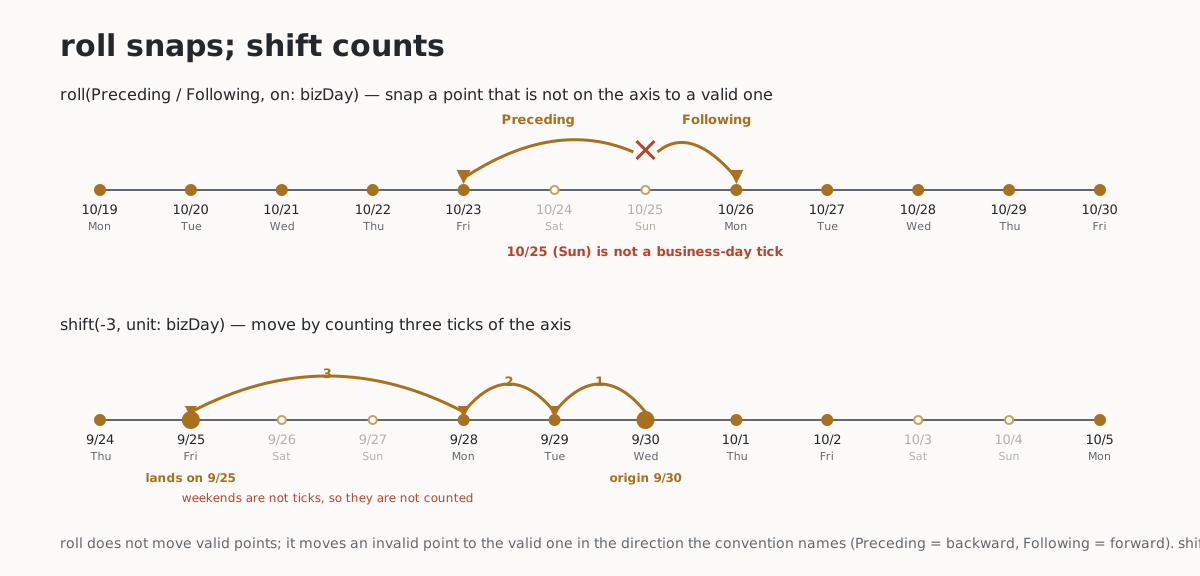
Moves each point by n steps in unit U. Direction is carried by the sign; no direction words
(back: and the like) are taken — once n becomes a variable, direction would be doubled
across a word and a sign (ADR-21).
U is a premise-relative axis name with two faces:
- Window units (
day,month, …) — move the index of the containing window. The offset within the window is preserved in elapsed time (ADR-31 revision 2 = F83. Landing = the start of the landing window + the elapsed offset. Crossing a DST transition day changes the wall clock — in NY,[3/7T09:00] |> shift(+1, unit: day)→ 3/8 10:00. Sticking to the wall clock is the declaring side’s business 〈the entity’s sessionOpens, the tick of a timed anchor〉. If the offset exceeds the landing window’s width it spills into the next window — nudging back is roll’s job). - Point-sequence axes (
bizDayand other discrete valid-point sequences) — move the position along the axis. A point not on the axis is a static error (nudge it onto a valid point withrollfirst; the spirit of I3).
Examples
3 business days before month-end (representative example §7.1. January: month-end 1/31 Sat → roll to 1/30 Fri → back 3 business days to 1/27 Tue):
# eval: 2026-01-01..2026-02-01
@JP
monthEnd |> roll(Preceding, on: bizDay) |> shift(-3, unit: bizDay)
#=> 2026-01-27
#~> 範囲外 2026-01-01..2026-01-02(holidays2026 covering 2026-01-01..2026-12-31, asof 2026-01-05)
Window units preserve the offset — Hachijūhachiya (87 days after the instant of Risshun, 2/4 05:02) moves with its time of day:
# eval: 2026-01-01..2026-06-01
@JP
sekki = [2026-01-05T17:23, 2026-01-20T10:45, 2026-02-04T05:02]
  covering: 2026..2026
  labels: [小寒, 大寒, 立春]
sekki |> filter(s => sekki(s) == 立春) |> shift(+87, unit: day)
#=> 2026-05-02T05:02
#~> 範囲外 2026-01-01..2026-03-29(sekki covering 2026-01-01..2026-12-31)
To land on a date, add snapTo(day) downstream.
Pitfalls
roll“nudges only when invalid” (valid points stay put);shift“always moves”. Holiday adjustment is roll; “N business days before” is shift — needing both is the standard idiom for month-end offsets.- A point that is not a business day under
unit: bizDayis a static error. Keep theroll |> shiftorder. - Variable-width range shift (a band of ±k days) is not introduced (it needs a fold; open item F26) — for fixed widths, enumerate with a union.
- Point-sequence axes (
unit: bizDay) require the input and the axis to agree in alignment (ADR-36). Window words (unit: dayand the like) are interval membership (offset-preserving within the window) and hence outside the check — moving timed points withshift(+87, unit: day)is legal (the Hachijūhachiya idiom). -
Annotations translate too (transport, ADR-37 decision 4): the input’s “unknown intervals” (out-of-coverage annotations) accompany the result as their image shifted by n units (spec §4.10 transport table). When the image of a coverage gap overlaps the evaluation range, an annotation appears even where no points fire — “no points came out” and “the absence is trustworthy” are different claims, and the transported annotation carries the latter.
- A point moved across the edge of the evaluation range is not in the output — evaluated over
[2026-08-01, 2026-09-01), 8/3 (Mon) moves to 7/31 undershift(-1, unit: bizDay), which is outside the range, so it disappears (the semantics are range clipping, spec §7.8). The reference implementation emits the warningwindow-clip: shift(-1) …(1.0 addendum 22). Evaluate over a wider range.