strideBy — step by width, “every w”
Translated from the canonical Japanese page reference/strideBy.md. The
source_shaabove records the source revision; a consistency check flags this page when the Japanese original changes.
Category: stride (body-layer core) · Signature: strideBy(w, from:) : Stream -> Stream ·
name settled (spec §5.4)
Meaning
Marks points at an equal spacing of width w from the origin from:. Where
stride takes “every n points of the input” (counting in points), strideBy
takes “every physical quantity w” (stepping by width) — the operator for cycles that do not
ride the calendar’s rhythm (one Martian sol, every 90 minutes, every 36 hours); together with
take and takeLast they form the stride family’s four operators,
split apart because the argument kinds differ (spec §4.7 · ADR-38/49/52).
The origin from: is mandatory (ADR-31; the rule shared with stride across the family).
from: is forward-only — nothing is generated before the origin (an evaluation range before
the anchor is silently empty). To lay a wall-clock tick over any period, pass a standalone time
literal Thh:mm as from: — anchoring at the epoch anchor day 1970-01-01 structurally removes
the gap (civil 1d width only; ADR-51). If you write a dated anchor, pick a date before the
evaluation range.
Examples
Every 36 hours (a composite width of elapsed time):
# eval: 2026-01-01..2026-01-05
@JP
everyInstant |> strideBy(36h, from: 2026-01-01)
#=> 2026-01-01 2026-01-02T12:00 2026-01-04
For every Martian sol, see the example in everyInstant
(strideBy(24h39m35.244s, from: …)).
Pitfalls
- Mind the width conventions:
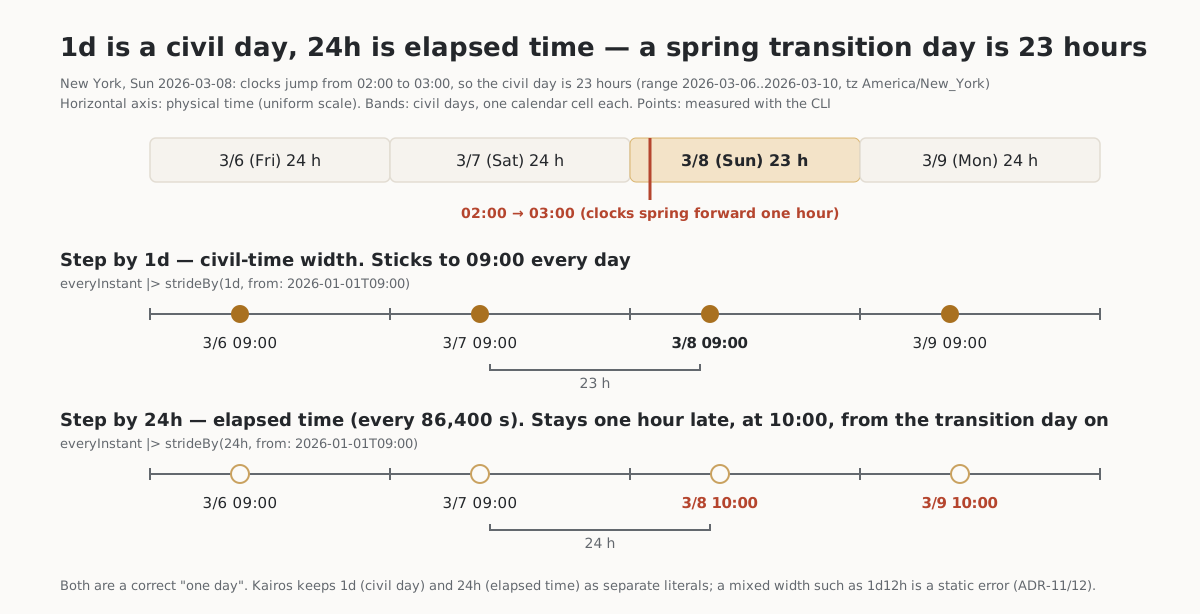
dis the civil day (it stretches and shrinks under DST; leap seconds are out of scope = ADR-33), whileh/m/sare elapsed time. Mixing (1d12h) is a static error (ADR-12/28). If you want “the same time every day”, use civil-time (calendar) operations; if you want “every 86400 seconds”, use elapsed time — the two diverge on DST days. - Thinning by count, like “every 3 business days”, is
stride.strideBydoes not count; it measures.
Related
stride · take · everyInstant · width literals
(spec §5.5 · ADR-11/12/28).