stride — thin the input points to every nth
Translated from the canonical Japanese page reference/stride.md. The
source_shaabove records the source revision; a consistency check flags this page when the Japanese original changes.
Category: stride (body-layer core; a family apart from selectors) / Signature:
stride(n, from:) : Stream -> Stream / name settled (spec §5.4)
Meaning
Scans the points of the input stream and keeps one point out of every n, counting from
the origin from: (input-relative = ADR-38 decision 10; it has no axis argument — what gets
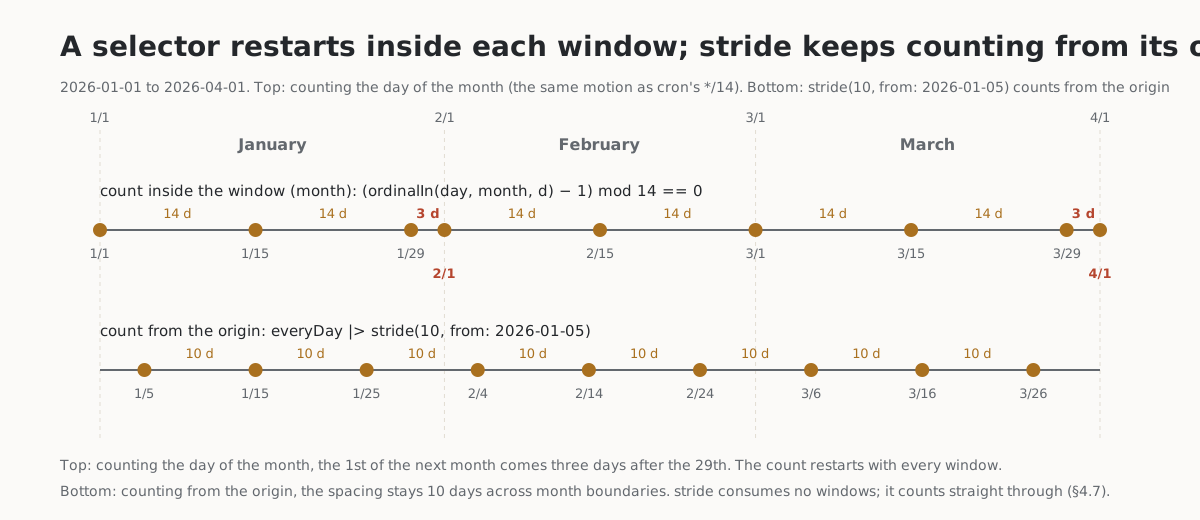
counted is decided by the preceding stage). Where a selector (nth) consumes windows
and picks “the Nth” resetting per window, a stride consumes no window and counts
continuously, ignoring boundaries — “every 3 business days, ignoring month boundaries” cannot
be written with selectors, and that is the stride’s reason to exist (ADR-11). Not “the Nth” but
“every N”.
The origin (phase anchor) from: is mandatory (absence is a static error). The former
“supplied from the upstream window’s origin” was abolished — with multiple windows it is ambiguous
and evaluation-range-dependent (ADR-31 · F49). The from: rule: the first input point at
or after from: is the counting origin (step 0 = it survives) — from: is not required to be a
point of the input (phase mix-ups are the danger zone stepped on in F32; ADR-38 decision 11).
n is an integer ≥ 1 — otherwise a static error (the “silently empty” of stride(0) is a
target of eradication; ADR-38 decision 12).
Examples
Every 3 business days (1/12 is a holiday; no reset across the month boundary):
# eval: 2026-01-01..2026-01-23
@JP
everyDay |> filter(on: bizDay) |> stride(3, from: 2026-01-05)
#=> 2026-01-05 2026-01-08 2026-01-14 2026-01-19 2026-01-22
“Biweekly from a specific day” is exactly the phase of from: (the answer to F103 of the
third feedback batch) — no year-anchor-parity workaround is needed, and no 52/53-week phase flip
across year boundaries occurs (the phase is held by from: = ADR-31/38):
# eval: 2026-01-01..2026-03-01
@JP
everyDay |> filter(d => weekday(d) == Mon) |> stride(2, from: 2026-01-05)
#=> 2026-01-05 2026-01-19 2026-02-02 2026-02-16
When you want a per-window reset
An every-n that recounts per window, like “the 1st, 8th, 15th, … of each month”, is written
not with a stride but by reduction to ordinalIn (it gets no dedicated notation;
ADR-27):
# eval: 2026-01-01..2026-02-01
@JP
everyDay |> filter(d => (ordinalIn(day, month, d) - 1) mod 7 == 0)
#=> 2026-01-01 2026-01-08 2026-01-15 2026-01-22 2026-01-29
Pitfalls
stride(n)counts the points of the input stream (input count; settled in ADR-38 — the axis-relative reading was retired). What gets counted is decided by the preceding filter — for every N business days, putfilter(on: bizDay)first. If “count along an axis, apply to another stream” is needed, compose it as(stride sequence of the axis) & input〈day-aligned〉 orfilter(d => coincides(strideSequence, day, d))〈timed;coincides〉.- Points before
from:are not output (the phase is fixed byfrom:). - To step by an absolute magnitude (a width that does not ride the calendar), use
strideBy.
Related
take (count and cut off — the first n points) · takeLast
(the last n points) ·
strideBy (count by points / step by width — the pair) ·
nth (window-relative “the Nth”) ·
ordinalIn (the reduction target of the window-reset variant) · ADR-11/31/38/49.