Kairos Language Specification — 3. The Premise Layer
Translated from the canonical Japanese chapter spec/20-premise-layer.md. The
source_shaabove records the source revision; a consistency check flags this page when the Japanese original changes.
The premise layer assembles and supplies the premises on which the body layer stands — calendar systems, calendars, axes, roll conventions, and the like.
3.1 What a premise is
A premise is the collective term for the preconditions under which the interpretation of an expression, clause, or phrase holds. It includes: calendar system (calendar-system), axis, calendar, roll convention, granularity, TZ, asof, WKST, and provenance (source). It plays for expressions the same role that a contract’s preamble (recitals) plays for the clauses that follow — laying down in advance the premises on which they stand. Streams (values) and operators (verbs) are evaluated on top of premises, but are not premises.
3.2 The preamble (premise declarations)
A preamble is placed before body expressions and governs the expressions that follow (effective until the next preamble). One and the same binding operation comes in three forms, long and short.
Declaring a premise of the same name twice in one program is a static error (a later declaration never wins silently;
1.0 addendum 22). Redefining a standard-library premise (Gregorian etc.) under its own name is still accepted. Writing the
same preamble member twice in one block is a static error as well (override through a derived with or the lightweight
postfix). An empty value of a dangerous member (tz: "") is an error, distinct from leaving it undeclared.
Definition (multi-line allowed) — defines the contents that @name bundles.
premise JP {
  calendar-system: Gregorian      # calendar system (structure)
  calendar:        TSE            # calendar (policy: business days)
  tz:              "Asia/Tokyo"   # TZ and source are string literals (ADR-32)
  wkst:            Mon
  asof:            latest
  source:          "cao.go.jp/official"
}
Lightweight form — lays a predefined bundle down as the preamble. @name is the same reference
whether it names a single-value alias (@TSE) or a multi-member bundle (@JP).
@JP
monthEnd |> roll(Preceding, on: bizDay) |> shift(-3, unit: bizDay)
Full form, inline — makes a preamble on the spot, without naming it.
premise { calendar-system: Gregorian; calendar: TSE; tz: "Asia/Tokyo"; wkst: Mon }
To bracket the scope explicitly, use the block form @name { … } (its interior is a sequence of
bindings and body expressions). Stage arguments override the preamble innermost-first.
3.3 Member slots and the governance of omission
The members are calendar system, calendar, axis, roll, granularity, TZ, asof, WKST, and provenance. Dangerous members — those whose mix-up produces silent wrong results — are declaration-required leaning; safe members may default. A dangerous member that can be resolved neither in the preamble nor at a stage is a static error.
| Member | When omitted | Why it is dangerous |
|---|---|---|
calendar-system (calendar system) |
May default (Gregorian) | A mix-up is caught by name ambiguity |
calendar (business-day calendar) |
Declaration required | No universal default exists / silently yields a different day. The value is a calendar entity (identity check, §3.9) |
axis (axis) |
Declaration required (no language default) | An axis mix-up gives a different result (shift’s 3 days vs. 3 business days) |
roll (roll convention) |
Declaration required | Mixing up how invalid points are moved is a silent wrong result |
wkst |
Declaration-required leaning | The origin of “the Nth” flips |
tz |
Declaration-required leaning | The local day drifts |
source (provenance) |
Declaration-required leaning | Confusing the official edition with a local override |
granularity (granularity) |
May default (“day”) | Explicit or default, the result is often unchanged |
asof |
May default (evaluation time) | Declare it when reproducibility matters |
Folding axes and rolls (scope defaults)
on: (roll, filter) and unit: (shift) name, premise-relative, the axis being operated on (bizDay / day / hour …).
- A cycle name (
weekday) is a label and does not resolve to a stream, so it cannot stand as an axis.strideis input-relative and takes no axis (ADR-38). - The axis resolves against the in-scope
calendar:(bizDayunder@JPis TSE’s business days). - Because axis names resolve, in the in-scope premise, to a stream of valid points, a derived stream may be passed directly as an axis (e.g.
roll(Following, on: nonHoliday)for substitute holidays. ADR-26). - When a premise name stands in the axis position (
on: TSE), the identity check requires it to be a calendar entity, and it is reinterpreted as “overridecalendar:for that stage only and read the standard derivationbizDay” (§3.9, ADR-35).
The redundancy of several stages writing the same axis can be folded by declaring the axis once as the preamble member axis:. A stage that omits it resolves from the in-scope axis:.
- This is a lexical scope default (default → evaluation context → block declaration → stage argument, innermost wins), not back-stage inference, so each stage’s locality is preserved.
- The same mechanism lets a roll convention be declared once as the preamble member
roll:(in a bundle definition, or postfixed to the lightweight form) and inherited by stages. Being a dangerous member, however, the convention is recommended to stay explicit. - A preamble member’s value is a convention name, the name of a point stream or premise, a string, a number or a date; a preamble member name is not a value (
roll: roll,axis: axisor the mutualaxis: roll; roll: axisis a self-reference error; 1.0 addendum 21).
# explicit (write the axis at each stage)
@JP
monthEnd |> roll(Preceding, on: bizDay) |> shift(-3, unit: bizDay)

# folded (give the body the axis default as a postfix)
@JP axis: bizDay
monthEnd |> roll(Preceding) |> shift(-3)

# a different axis for one stage only (innermost wins)
@JP axis: bizDay
monthEnd |> roll(Preceding) |> shift(-3, unit: day)
3.4 Name resolution is premise-relative
Names resolve to values under the current premise. If several premises supply the same name, it is
ambiguous and requires qualification (Gregorian.month). “Meaning is premise-relative” extends
beyond values to names. Unique: bare name; ambiguous: qualify with the enclosing entity;
unresolved: error.
3.5 Value expressions and variables
The premise layer has value expressions that are not time streams. The operators are chosen so as
not to collide with the combinators (&, |, \).
| Kind | Symbols |
|---|---|
| Arithmetic | + - * /, remainder mod, integer division div (words). div is floor division and mod the mathematical remainder (they disagree with trunc for negative dividends. ADR-31 revised, F63) |
| Comparison | < <= > >= == != |
| Logic | and, or, not (words; the symbols &/| are reserved for the combinators) |
| Conditional | ternary cond ? a : b |
| List | literal [a, b, …], indexing l[i] (0-based), membership predicate x in l |
| String | literal "…" (no newlines, no escapes; used for TZ and source values. ADR-32) |
| Binding / equality | = is binding (definition), == is equality comparison |
Bindings of value functions and value constants may be written both inside premise blocks and at
file top level. Top-level bindings are lazily resolved in the in-scope premise, just like sugar
definitions (§4.8) — “= is the same binding everywhere” (ADR-28).
Lambdas and higher-order functions — some operators take not a value but a function as an
argument (higher-order functions). The window-generating words span/split (§3.6) and the
filter filter (§4.6) are all higher-order functions that receive “how to treat each element” as a
function (cycle takes a list of labels, so it does not count). An anonymous function passed on
the spot is called a lambda, written arg => expr (the arrow => is distinct from the type
notation ->). For example, y => y mod 4 == 0 is the function “take a calendar year y and
return whether it is a multiple of 4.” A lambda may be bound to a name (isLeap = y => …) or
passed directly to a higher-order function in place (filter(x => …)).
Predicates and variables — a predicate (a lambda returning a boolean) binds each element of its
subject. where is merged into filter: filter takes both premise predicates (on:) and
value-expression predicates (lambdas). References go through the binding name, so nesting is never
ambiguous.
isLeap = y => y mod 4 == 0 and not(y mod 100 == 0 and y mod 400 != 0)
3.6 Primitive definitions of calendar systems
A primitive definition (Gregorian and the like — a root with no derivation source) builds a
calendar system by carving the continuous base Chronos into windows, and produces public words. The
window-generating words are three plus one (grid/span/split, which make windows, and cycle,
which produces labels, not windows). All three window-making words produce partition-type
windows (§4.2), so exhaustiveness and non-overlap are structurally guaranteed (I5). This section
explains how to write a primitive definition, with Gregorian as the example. For the
exhaustive account of Gregorian itself (each word, the separation of weekday and WKST, scope),
see stdlib/gregorian.md.
Dependencies are primarily bottom-up aggregation: the atom day is bundled into month, and
that month into year (month is the basic grouping). Only year’s dependent window
(quarter) is made by split-ting year, so that it tracks changes to year automatically.
| Word | Kind | Meaning |
|---|---|---|
grid(w) |
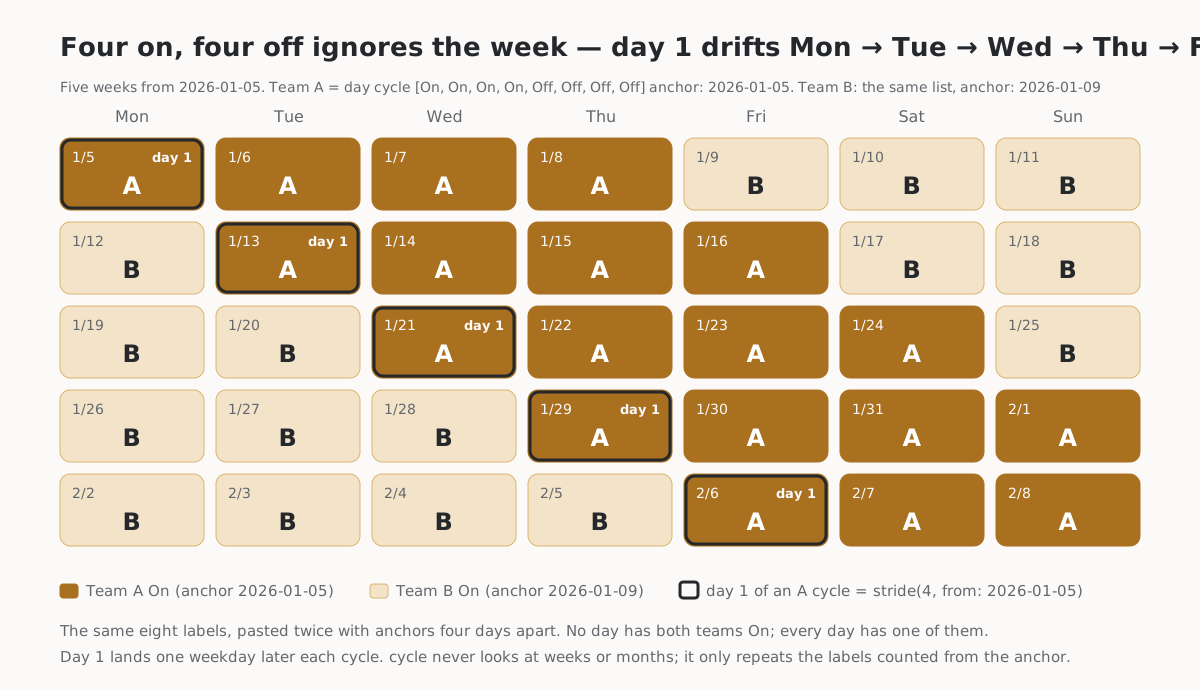
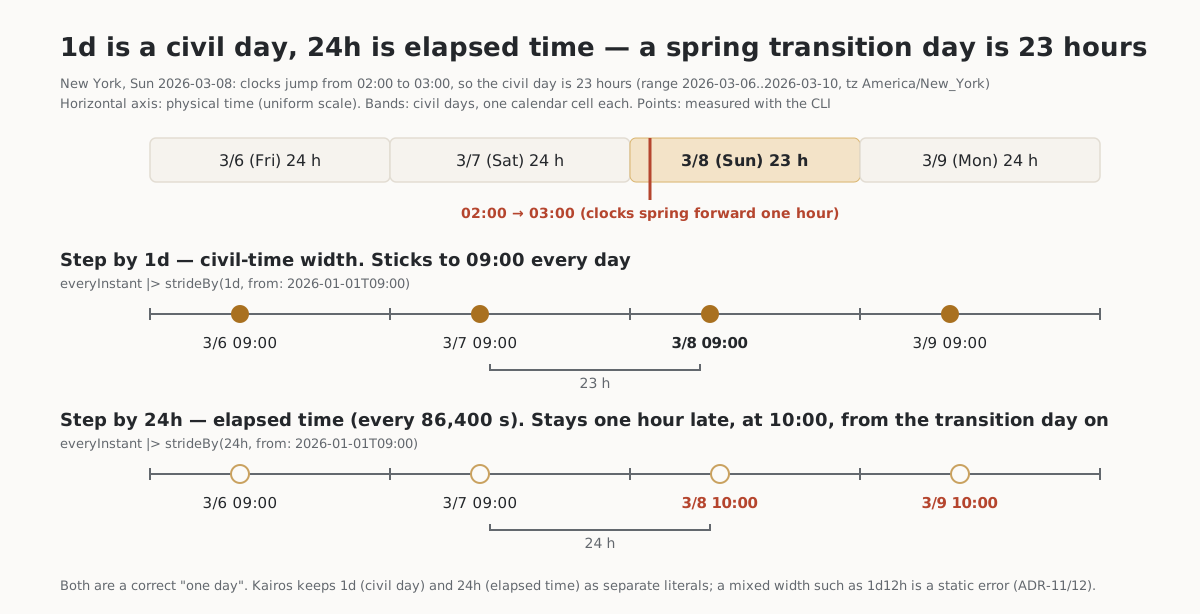
Uniform partition | Tiles the continuous axis into equal widths w. Makes the calendar’s atoms. w follows the civil-time width convention (1d = 1 civil day, not a fixed 86400s; a civil day is 23–25 hours on DST transition days. Leap seconds are out of scope = chronos is a uniform idealized axis without leap seconds (each UTC day = 86,400 seconds). ADR-11/12/33). Phase defaults: civil-time widths align to the start instant of each civil day in the in-scope tz: (midnight on ordinary days. ADR-31 revised); elapsed-time widths align to the epoch; overridable with anchor: (ADR-31) |
span(f) |
Variable aggregation (bottom-up) | Bundles a sequence of finer units into contiguous windows. f = n => count binds the ordinal n (epoch-origin) of the window being generated and returns the number of units to bundle. The count may be variable (month’s day counts) or constant (year’s 12) |
split(g) by: u |
Variable division (top-down) | Divides a parent window into contiguous subwindows. g = y => [widths…] binds the parent’s running window-sequence ordinal y (the F60 coordinate) and returns the list of subwindow widths. by: u makes the width unit explicit. Parent and u accept, beyond partition windows, effective partitions from rule markers (segmentBy-built window sequences without coverage annotations) — data-borne (covering-carrying) parents, empties: drop parents, and cycles are rejected (ADR-48). Two per-instance checks: boundary alignment (both parent ends on u window boundaries — misaligned pairs 〈calendar year × week〉 are rejected here) and the I5 sum (widths sum = u count inside the parent; mismatch is an error). Used for dependent windows |
cycle(labels) anchor: |
Parallel labels | Attaches repeating labels to the target partition windows. Produces labels, not windows. The period length is arbitrary (7, 10, 12, 60, …) and so is the target window (not just day’s weekdays — month and year work too; the sexagenary cycle is year cycle […]). anchor: is an instant meaning “the target window it belongs to takes the first label”. The binding name reads, in value expressions, as a point → label value function (filter(d => weekday(d) == Mon); resolution is two steps: point → containing window → label. ADR-27) |
Leap is a value, not a window (the pivot that fixes the dependency direction)
“Does February have 28 or 29 days?” looks like a dependency on the window year, but it is in
fact a value dependency computable from the month’s serial number m (derive the calendar year
and month position from m, then decide with isLeap). Hence month need not depend on the
year window, and month can stand as the basic grouping (bundling day). If month were made a
child of year (year split), then when a derivation (the fiscal calendar, §3.7) re-bundles
year from month, month ↔ year would become circular. Viewing leap as a value dependency and
placing month as the parent keeps the cycle from ever arising — this is the ground on which the
fiscal calendar can be written in one line, with no workaround.
Public words
Only bindings at the block’s top level are public, referenced with . as in Gregorian.month.
Boundaries are derived by reusing the body layer’s selectors (zero new machinery). The generator
monthEnd (yielding the calendar-day month end) is in reality this public boundary word
month |> last itself: a “generator” is a public boundary word of a primitive definition (not a
separate mechanism).
premise Gregorian {
  day     = chronos grid 1d                                 # atom (carve the continuous axis into civil days)
  weekday = day cycle [Mon, Tue, Wed, Thu, Fri, Sat, Sun] anchor: 2000-01-03

  isLeap      = y => y mod 4 == 0 and not(y mod 100 == 0 and y mod 400 != 0)
  daysInMonth = m => monthLengths(isLeap(yearOf(m)))[monthOf(m)]  # leap computed as a value from m (no year window)
  month   = day   span daysInMonth label: (p => monthNo(p))        # basic grouping: bundles day (year-independent)
  year    = month span (_ => 12) phase: 0 label: (p => yearNo(p))  # bundles month twelve at a time
  quarter = year  split (_ => [3, 3, 3, 3]) by: month       # year's dependent window (auto-tracks in fiscal calendars)

  weekStart = day |> filter(d => weekday(d) == wkst)        # wkst lazily resolves the user-side preamble declaration
  week      = day |> segmentBy(weekStart, edges: clip, empties: error)

  monthStart = month |> first                               # public boundary words (selector reuse)
  monthEnd   = month |> last
  yearStart  = year  |> first
}
The auxiliary value functions yearOf(m) / monthOf(m) / monthLengths(bool) are value
expressions that return the calendar year, month position, and day-count list from a month ordinal
m (they do not reference the year window). Bindings resolve in dependency order
(day → month → year → quarter). Mutual reference is allowed; cycles are errors.
The epoch at which the window ordinals n and m originate is by language default
1970-01-01T00:00 (in-scope tz). A calendar system with a different basis (a Martian calendar, etc.)
may override it with the primitive-definition member epoch: (a value intrinsic to the
calendar system; it cannot be placed in the user-side preamble. Ordinals are 0-based — the
coordinate in which monthOf(m) = m mod 12 holds. ADR-31). Since the epoch is a preimage under the
in-scope tz’s mapping, a different tz means a different point on chronos — epochOrdinal and
span ordinals are premise-relative coordinates (ADR-33 decision 7).
week references wkst: (a preamble member) on its right-hand side and is lazily resolved in
the user side’s in-scope premise (the same rule as sugar definitions, §4.8; within(week) with
no wkst: declared is a static error). Generation uses segmentBy (interval-sequence type), but
because the weekday cycle lets exhaustiveness and non-overlap be proven by the I5 check, it can be
used with within(week) — partition-hood is established by the check, not by the generating word
(stdlib/gregorian.md §4.5).
The right-hand side of a premise binding may contain, besides value expressions and
window-generating words, body-layer stream expressions (pipe sequences like weekStart above,
segmentBy, table literals §3.8) — a consequence of “vocabulary is shared with the body layer”
(ADR-25); the type of a public word is determined by the type of its right-hand side (window /
label / value / stream. ADR-26).
Gregorian is a mathematical model on an idealized continuous time axis; it bears no historical
facts (the date deletion/duplication of the 1582 calendar reform, regional differences, leap
seconds (positive and negative; chronos idealization = ADR-33), the calendar’s period of validity).
When needed, handle them with a separate premise (a historically attested edition) or with
asof/source annotations.
The firing point of tz: (ADR-33): tz: is declaration-required leaning and fires at use
(isomorphic to wkst:) — an evaluation that requires the chronos→civil-coordinate mapping — the
anchor of a date literal, civil-width grid, snapTo(day), and the like — errors if it cannot
resolve tz: in scope. Expressions that do not use the mapping stand without a declaration. The
definition of TZ (mapping, civil day, gaps/overlaps, leap seconds, versions) is in ADR-33.
3.7 Derived definitions of calendar systems
A derived definition makes a new premise by overriding or extending an existing premise’s public words (the premise → premise closure). The core is with override: on top of the base, only the named public words are replaced; the rest is inherited.
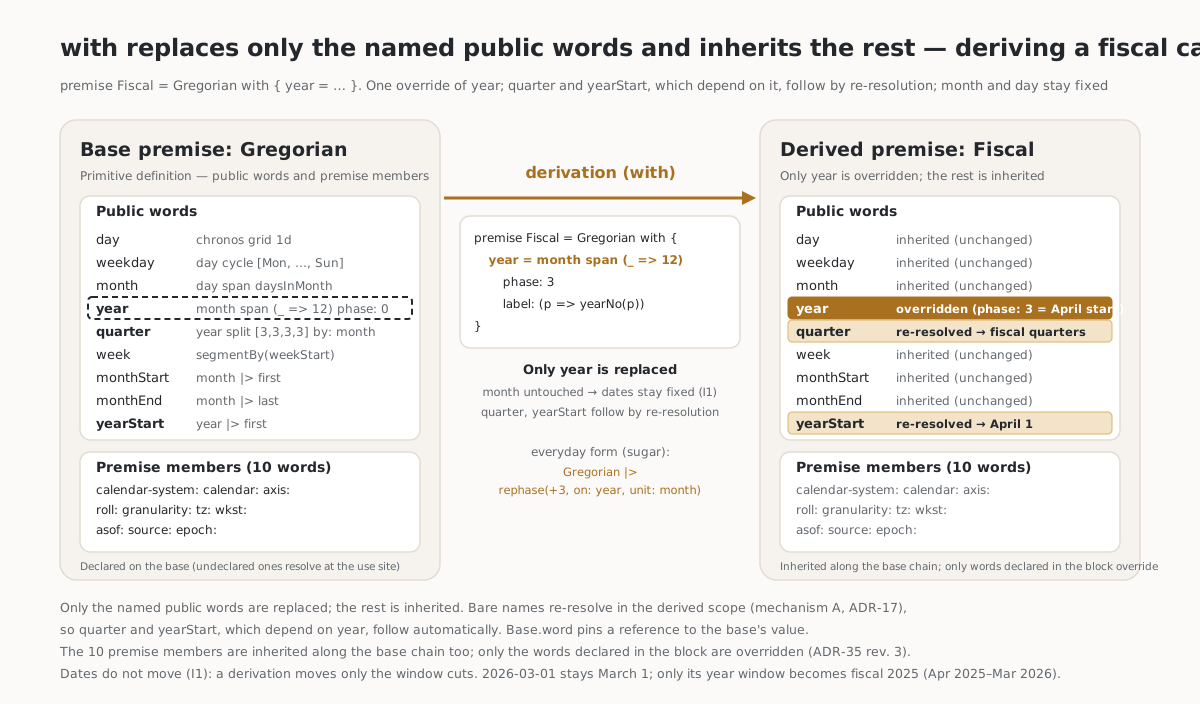
Premise members are inherited along the base chain as well, and the block’s declarations override them (ADR-35 revision 3, 1.0.2).
- All 10 words:
calendar-system:,calendar:,axis:,roll:,granularity:,tz:,wkst:,asof:,source:,epoch:(the list was made precise in 1.0 addendum 21). - The entry premise’s body sees the same set that the inside of a public word sees (the member resolution rule of §3.9).
- That a derivation overriding
nonWorkingshould also overridesource:(§3.9, declaration leaning towards required) is unchanged.
premise Fiscal = Gregorian with {
  year = month span (_ => 12) phase: 3 label: (p => yearNo(p))   # April start. label: is not inherited on override = attach it alongside (F96)
  # month is untouched, so calendar months and month ends stay fixed (inherited from Gregorian as-is)
  # quarter's inherited definition (year split by month) auto-tracks the new year → fiscal quarters Apr-Jun/…
}
Name resolution (mechanism A):
- Bare names re-resolve in the derived scope — the override (
year) shadows, and the inherited words depending on it (quarter,yearStart) automatically follow the new word. This is why the fiscal calendar takes a singleyearline. - A qualified reference
Base.wordpins to the base’s resolved value — the explicit means for deliberately fixing an inherited word to the base value. The fiscal calendar does not overridemonth, so no pin is needed (by §3.6’s “leap is a value”, nomonth ↔ yearcycle arises).
Dates do not move (base-fixedness I1) — a derivation moves only the windows’ cut points.
Calendar days, day/month, monthStart are fixed. 2026-03-01 remains “March 1”; only the year
window it belongs to changes (fiscal 2025 = Apr2025–Mar2026).
The pipe is sugar; expansion is a single phase shift of span — the everyday form is
premise Fiscal = Gregorian |> rephase(+3, on: year, unit: month). rephase is sugar
expanding to the with above, with the expansion rule:
rephase(δ, on: W, unit: U)  ≡  W = U span (_ => k) phase: ((φ₀ + δ) mod k)   # negative δ is also normalized by the modulus (F65)
#   k  = the number of U's contained in W (12 for year ⊃ month)
#   φ₀ = W's phase in the base (0 for Gregorian's year)
View W as “a span bundling U in groups of k” and simply advance its phase by δ. Pairs where
k is not constant (shifting month ⊃ day in units of day, etc.) are not fiscal-calendar-type
operations and lie outside rephase’s reach (a separate operator if ever needed).
An orthogonal, separate knob — year numbering (“fiscal 2025” = the starting calendar year /
US FY = the ending calendar year) is a projection of ordinals and labels independent of window
cutting, with conventions that differ by country. It is not baked into rephase but absorbed
into the labeling side (label: attachment expressions) of the window→value projection family
(§4.9, ADR-27). The binding rule of attachment expressions is settled by ADR-34 — the lambda
receives the window’s first point (label: (p => yearNo(p)) labels with the starting calendar
year); adjacent-window reference is out of reach (§4.9). rephase expands preserving the
base’s label: (the cut knob and the label knob are orthogonal), and the composite phase is
normalized modulo k (F65).
3.8 The intake for data (table literals)
Sequences that cannot be generated from periodic rules — the gazette-proclaimed vernal and autumnal
equinoxes, new moons, the twenty-four solar terms, year-limited special days — are brought into a
premise with a table literal (ADR-26). A list of instant literals is promoted to a time-stream
constant (the syntax is identical to value lists, §3.5; the type is determined by the elements).
The sequence must be ascending (out of order or duplicates are static errors).
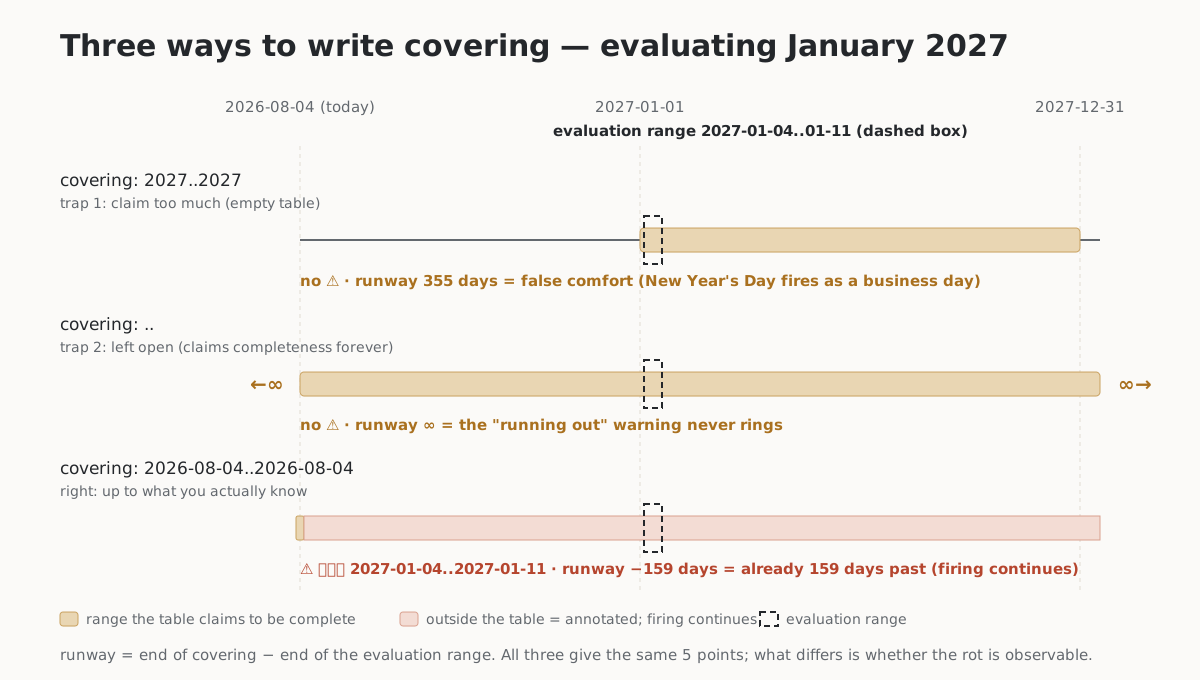
The empty list [] is promoted only when covering: is postfixed (the empty table = the
primary form of “zero points, but the coverage is to be claimed”. ADR-45 — the vessel for writing
the supply layer’s “nothing at all yet” as a legal source. Having no elements, its type is
determined by the presence of covering:, and each of the containment, ascending-order, and
labels: same-length checks (only labels: [] is legal) holds vacuously; alignment is vacuous
conformance = §4.5).
premise JPGazette {
  source: "cao.go.jp/official"      # provenance (declaration-required leaning: mixing up data provenance is dangerous. string = ADR-32)
  asof:   2025-02-03                # edition (data as of this gazette)
  tz:     "Asia/Tokyo"              # fixes the data's civil days on the inside (ADR-33 decision 10, F54)
  vernalEquinoxDay = [2025-03-20, 2026-03-20, 2027-03-21] covering: 2025..2027
}
A premise containing a table literal is source: declaration-required leaning. The edition is carried by asof:.
- A premise with
covering:or a date table must declaretz:(the ends of the coverage resolve as civil days of the premise’s tz; undeclared, the coverage would move with the user side’s tz. ADR-37).
Coverage covering:: a two-faced claim — “complete inside the range, unknown outside it” — that does not touch the values (the values are exactly the written sequence). It is written in one of three forms: open-ended, interval list, or postfix on a binding.
- Consistency of claim and values is a static check — every element of the sequence must be contained in covering (a violation is a static error of the same rank as out-of-order and duplicates).
- Evaluation outside the range flows into the evaluation annotations (I6, §4.10) as an out-of-coverage provenance, distinguished from an “accidental empty”.
- When omitted, the range is the ends of the sequence (closed interval) — the empty table, having no ends, requires an explicit covering: (omission is a static error with guidance. ADR-45).
Open-ended: covering: 2021.., ..2027, .. (a claim of completeness over all time = produces no annotations; the receptacle for a one-off exclusion table [2026-01-05] covering: ..).
- Completeness is an unverifiable claim, so governance applies —
source:/asof:declaration-required leaning, and permanent display in the coverage summary (§4.10). - Note that omission (narrowest) and
..(widest) are opposite claims.
Interval lists: covering: 2020..2022, 2024..2027 (an honest declaration of gapped data).
Binding-postfix = explicit coverage claim: the composition nonWorking = (satSun | h2024 | h2025) covering: 2024..2025 claims “this composition is complete over this range”.
- The component coverages’ annotations are replaced by this binding’s claim — the sole outlet for cancellation; there is no automatic cancellation.
- Necessary-condition static check: within the claimed range, every interval that would carry an annotation must be contained in the covering of some data component.
- A rule component’s “all time” does not count — a completeness claim over an interval no data component can speak for is pushed down to an open-ended covering on the component table’s side (ADR-37 decision 5, revised).
The range literal 2024-02-10..2024-02-17 is sugar expanding to an enumeration of consecutive days.
Labeled tables (labels:. ADR-30): attach to the instant sequence a label sequence of the same length, defining a point→label projection.
- The binding name is itself the projection name (the same rule as cycle binding names) —
sekki = [2026-01-05T17:23, …] labels: [小寒, 大寒, …]makessekki(d)return the solar-term name. - Points do not store labels; labels are read through the projection (§4.9) = no record type is introduced.
- cycle (infinite rhythm) and label sequences (finite data) differ only in their source.
A calendar system that carves windows with data (a lunisolar calendar cut at new moons) is the same premise type.
- What calendar-system purity (I8) forbids is a generator’s dependence on a calendar (business-day policy), not a calendar system’s dependence on data.
- The purity distinction is drawn not by type but by provenance (
source:/asof:) (ADR-26).
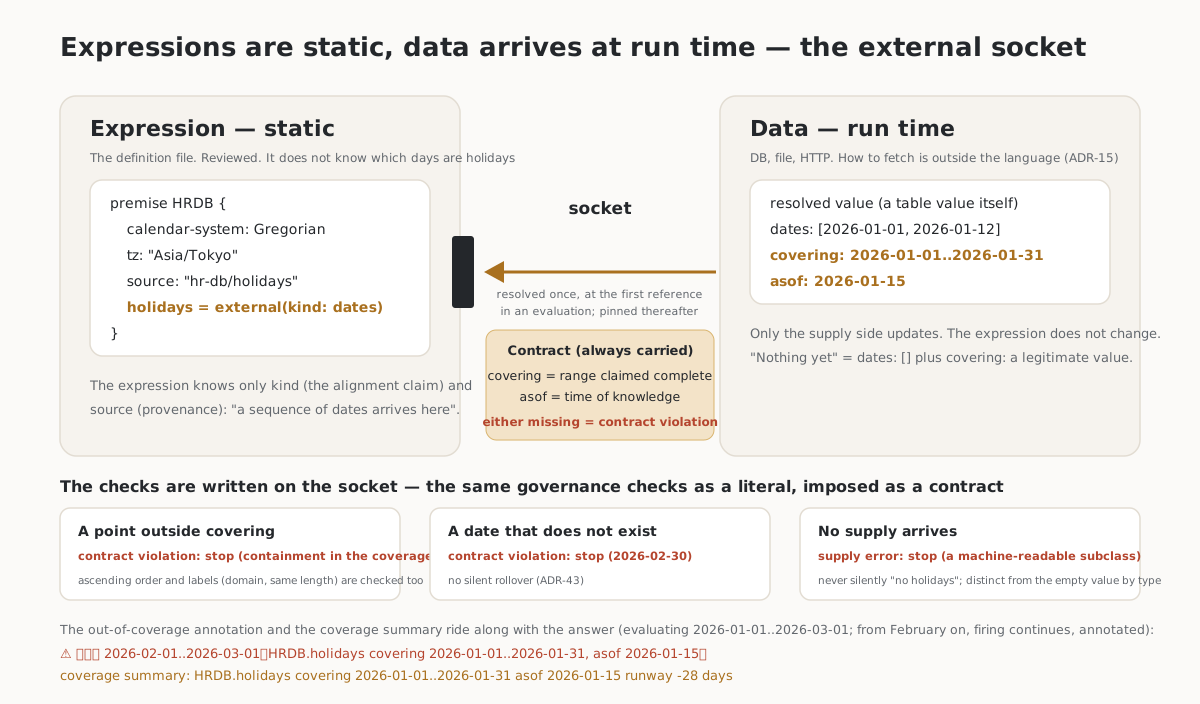
The external supply declaration external (ADR-46) — the socket for “expressions are static, data resolves at run time”.
name = external(kind: dates | instants [, labels: [domain]] [, source: "…"])may be written only as the right-hand side (its head) of a premise binding (body-layer and under-preamble bindings are static errors — the governance of source:/tz: must live on the premise).kind:is the alignment claim (dates= the civil-day grid of the definition side’s tz;instants= none — the declaration stands in for the literal text; even when empty, as declared = independent of the resolved value’s row count).labels:is the enumeration of the value domain (static knowledge for bare-name label comparison).- A premise with external must declare
tz:.
The resolved value is a table value itself, and the same governance checks as for literals apply as the supply contract.
- covering and asof are always carried by the resolved value (absence = contract violation). Containment / ascending order / same length / date existence are likewise checked at resolution.
- asof is a version identifier: used only for identity (detecting a mismatch with the declared
asof:), never ordered or read as a date (its format is a convention of the supply contract — the language’s as-of mechanism is not tied to the notation of the Gregorian premise, which is just one premise. 1.0 addendum 23). - Resolution is an adjunct of the evaluation context (once per evaluation, at first reference; snapshot-pinned; the means of acquisition is outside the language = ADR-15).
- A resolution failure is a supply error (a machine-readable subclass — distinguished by type from “nothing yet” (empty data + covering)).
-
Details in
reference/external.md. The resolution flow (one resolution per evaluation, the supply contract, the type distinction between “nothing yet” and failure):sequenceDiagram participant E as Evaluation (body layer) participant X as external binding (the expression is static) participant R as Resolver (means of acquisition outside the language = ADR-15) E->>X: First reference in the evaluation (demand-driven — no resolution if never referenced) X->>R: Resolve (once per evaluation) alt Acquisition succeeded R-->>X: Table value [point sequence, covering, asof (required), labels?] X->>X: Supply-contract check = the same governance as literals<br/>(kind alignment, containment, ascending order, labels domain/length, date existence) Note over X: A contract violation is an evaluation error<br/>(error.kind supply since 1.0.11, addendum 28 — the firing layer<br/>degrades instead of stopping, Appendix A A.4; the same wording system as literals) X-->>E: Snapshot-pinned — later references in the evaluation see the same value<br/>(determinism is "relative to the same snapshot". §7.8) Note over E,X: "Nothing yet" is a legitimate empty = [] covering: … (ADR-45) —<br/>passes the checks by vacuous conformance. The value is empty, the danger observed via annotations (§4.10) else Acquisition failed R--xX: Resolution failure X--xE: Supply error (a machine-readable subclass of evaluation error — distinguished by type from "nothing yet") end
The naming status is in §5.4: grid, span, split, cycle, anchor:, phase:, by:, with,
chronos (the lexical name of the base. ADR-29), and axis: (the operating axis) are settled, and
RC2 also settled covering:, labels:, and label: (table and attachment sides). Naming is final
for every word — the last placeholder was settled as rephase (2026-07-26, formerly
shiftBoundary; together with the batch confirmation F51 of 2026-07-09, no placeholders remain.
§5.4). The lexis of date and width literals is settled (ADR-28/43, §5.5).
3.9 Calendar entities (ADR-35)
The entity given to the calendar: member (TSE, JPCal, etc.) is a premise that has the reserved
public word nonWorking. There is no dedicated declaration syntax — the syntax for bundling
“stream bindings + source:/asof:” already exists in premise definitions (§3.2) and the
layer-crossing rule (end of §3.6, ADR-26); the only thing specific to calendar entities is the
designation of “which binding is the non-working set”.
premise TSE {
  calendar-system: Gregorian          # needed to resolve weekday (the definition of satSun)
  tz:     "Asia/Tokyo"                # fixes which civil day a non-working "day" is (inner-fixed, ADR-33)
  source: "jpx.co.jp/trading-calendar"
  asof:   2026-01-05

  satSun     = everyDay |> filter(d => weekday(d) == Sat or weekday(d) == Sun)
  holidays   = [2026-01-01, 2026-01-12, …] covering: 2026..2026
  nonWorking = satSun | holidays      # reserved public word = the entity's "identity"
}

premise JP {
  calendar-system: Gregorian
  calendar:        TSE                # only a premise publishing nonWorking may stand here
  tz:              "Asia/Tokyo"
  wkst:            Mon
}
The type requirement is an identity check (an extension of ADR-19): only “a premise with the public word nonWorking (time-stream type, argument-less binding)” may stand at calendar:. Placing a premise without it is a static error.
- The identity check further requires (a)
nonWorkingis aligned to the civil-day grid of the entity’s tz (§4.5 — the operational definition of “read the entity at day granularity”), and (b) the entity declarestz:(required) (the enforcement point of inner-fixing (ADR-33) is the declaration). - The identity check runs at the first use as an entity (resolution of
calendar:; reinterpretation at an axis position).
Calendar-system premises and calendar premises are the same premise type, distinguished by identity = the aspect of their public words.
- The reverse mistake — placing an entity in the
calendar-system:position — is caught by “a premise withnonWorkingmay not stand atcalendar-system:”. - Granularity is not part of the type — fine-grained points such as half-day-holiday non-working time bands and business hours are also in reach, as other time-stream bindings within the same entity (
nonWorkingalone is the day-aligned reserved word; the fine-grained layer’s conventions are below, ADR-41).
The standard derivation of bizDay is prescribed uniformly by the language: with the in-scope calendar: entity as C, a derivation sugar equivalent to bizDay = everyDay \ C.nonWorking (lazily resolved; the same rule as §4.8).
- The bare name
everyDayresolves in the user side’s in-scope premise, whileC.nonWorkingis pinned to C (mechanism A). - Where
calendar:is in scope,bizDayis a language-reserved derived name (a manual binding is a static error; out of that scope it remains a free binding name as before). - A derivation in which the entity’s
tz:and the user side’stz:disagree is stopped by the alignment check (§4.5, ADR-36) as a safe-side error. - The standard derivation propagates
nonWorking’s evaluation annotations (the out-of-coverage provenance ofcovering:) (I6; the propagation rules are §4.10, ADR-37 — the difference\takes the union of both sides’ annotations, so the degeneration beyond where holiday data runs out does occur but is observable).
Premise names in the axis position (F53’s convention): a name at on:/unit:/axis: resolves normally if it resolves as a binding; is reinterpreted if it resolves only as a premise name; and is ambiguous = a static error if it resolves as both (ADR-17).
- A premise name P is required by the identity check to be a calendar entity, and is reinterpreted as “override
calendar:to P for that stage (or that scope) only and read the standard derivationbizDay” —roll(Preceding, on: TSE)≡ “roll(Preceding, on: bizDay)in the context ofcalendar: TSE”. - A premise name that is not an entity is a static error. The reinterpretation’s ripple extends only to the resolution of that axis.
-
The full resolution path (the axis-position face of §2.7 “position-dependent name interpretation”):
flowchart TD
  X["Axis-position name X (on: / unit: / axis:)"]
  X --> B{"Resolves as a binding (stream)?"}
  B -- "yes" --> C{"Also resolves as a premise name?"}
  C -- "yes" --> AMB["Ambiguous = static error (never chosen silently)"]
  C -- "no" --> S["Normal resolution — the derived stream is the axis"]
  B -- "no" --> P{"Resolves as a premise name?"}
  P -- "no" --> E1["Unresolved = static error"]
  P -- "yes" --> ID["Identity check: nonWorking (day-aligned, argument-less) + tz: declared"]
  ID -- "fail" --> E2["Static error (not a calendar entity)"]
  ID -- "pass" --> DER["Reinterpretation: read the standard derivation bizDay in the context of calendar: X"]
Member resolution rule (the codification of “pin to the resolved value”, ADR-35): the preamble members of definitions evaluated under a qualified pin (C.word) or an entity reinterpretation follow definition-side precedence.
- Members that C (and its base chain) declares are fixed to C’s values, and only undeclared members resolve in the user side’s scope.
- The inner-fixing of
tz:and the lazy resolution ofwkst:fold into this one line.
Overriding uses the existing with (§3.7): premise MyCompany = TSE with { source: "intra.example.com/holidays"; nonWorking = TSE.nonWorking | companyHolidays }.
- Base references on the right-hand side use the qualified pin (a bare name would be a self-reference to the word being defined).
- A derivation that overrides
nonWorkingoverridessource:as well (declaration-required leaning) — inheriting it silently would let altered data claim the official provenance.
Squaring with cascades (ADR-01): add-back and inversion override compositions are expressed on the right-hand side of nonWorking (declaration order and left association per §4.5).
- Mainland China’s tiaoxiu (State Council holiday arrangement) is
nonWorking = (satSun | holidays) \ workdaysSpecial. - Filtering appears only at the final stage of the standard derivation, and the composition leading up to it carries the cascade — not a regression to “the residue of filtering”.
Governance is demand-driven: an entity premise does not itself require calendar:. If a binding inside the entity uses a bizDay-family axis, it requires the entity’s own calendar:; self- and mutual cycles are static errors.
Orthogonal to the external supply declaration: the right-hand side of holidays may be a table literal or external(kind: dates) (§3.8, ADR-46).
- The vessel’s alignment claim is carried by
kind:— resolving the ADR-36 corollary. - Even with empty data the entity boots and bizDay degenerates to everyDay (observably).
Cross-tz use (using the Tokyo entity from an NY premise, etc.) is outside the reach of the axis-position sugar.
- The explicit form
everyDay \ (TSE.nonWorking |> snapTo(day))means “read the overlap on chronos through the user side’s day boundaries”. - An explicit reconciliation of “the same date label” is written with
rebase(to:)(§4.4, ADR-40).
3.9.1 The fine-grained layer — business-hours supply conventions and standard derivations (ADR-41)
Besides nonWorking, an entity may declare the paired reserved public words sessionOpens and
sessionCloses — the opening sequence and the closing sequence (time-stream type,
argument-less) (optional; the declaration is a pair = declaring only one is a static error; under
with derivation the judgment includes inheritance). The points are facts in the civil
coordinates of the entity’s tz (wall clock — the enforcement form of “whether DST shifts them or
not is a decision of the premise layer’s culture”; the rules are the civil grid of a time-of-day
anchor (§3.6, ADR-31 revision 2) or civil-time widths with strideBy; the exceptions are
compositions of time-of-day tables). A session = the union of half-open intervals
[open_i, close_i). Overnight sessions (crossing days) are legal; 24-hour operation is outside
this vessel (express it at the day-granularity layer).
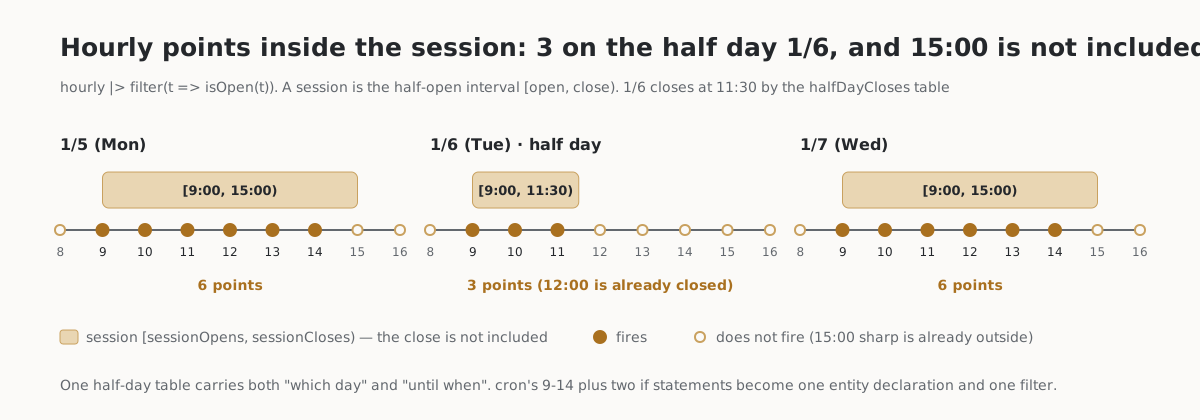
Consistency check (data-relative layer; at first use of a fine-grained derivation): over the domain = joint effective coverage ∩ materialization range, adjacent markers must alternate in kind (an isolated close/open at an edge is legal as a notch). For a simultaneous open/close both points must exist, and their order is unique from the alternation requirement (close→open = continuous operation / open→close = zero width) — the handling of firing for simultaneous events belongs to the firing layer (out of scope).
Standard derivations (reserved where calendar: is in scope, when entity C declares the pair): bizOpen = the points of C.sessionOpens whose opening day (a civil day in C’s tz) is a business day of C; bizClose = each session’s closing point; isOpen(t) = whether t lies in the union of the bizOpen sessions’ intervals (a value predicate).
- The derivations are entity-relative — the decision inputs (holidays, tz) resolve in the entity’s culture and do not depend on the reader’s premise (a different role from day-granularity
bizDay= consumer-relative). - A session’s business-day-ness is read from its opening day (an overnight session’s tail follows its opening day).
- Coverage follows the witness rule’s three branches (true = an unannotated decision; out-of-coverage = the decision depends on annotated intervals of sessionOpens/sessionCloses/nonWorking; false = coverage complete. §4.10).
- No
bizHour-style point sequence is derived — granularity is the expression’s choice (hourly |> filter(t => isOpen(t))).