segmentBy — interval-sequence windows (cut at markers)
Translated from the canonical Japanese page reference/segmentBy.md. The
source_shaabove records the source revision; a consistency check flags this page when the Japanese original changes.
Category: window (body-layer core) / Signature:
segmentBy(m, edges:, empties:) : Stream -> Stream(interval) / name settled (spec §5.4)
![The four ways to make windows, drawn over the same nine-week strip of days (Mon 2026-01-05 to Sun 03-08): within(month) divides the axis by month, split divides the parent week into dependent windows of widths [5, 2], span bundles days five at a time (from the epoch, so starting 1/2), and segmentBy cuts intervals at new-moon markers with no window before the first marker (edges: drop). The dots in each row are the first of each window.](../../assets/figures/windows-four-kinds.svg)
Meaning
Takes an arbitrary stream m as markers and makes each half-open interval [mᵢ, mᵢ₊₁) between
adjacent markers a window. Every window whose boundaries are given by a sequence of points — fiscal
closes, lunar phases (a lunisolar calendar cut at new moons), weeks (cut at the wkst-labeled day)
— stands on this.
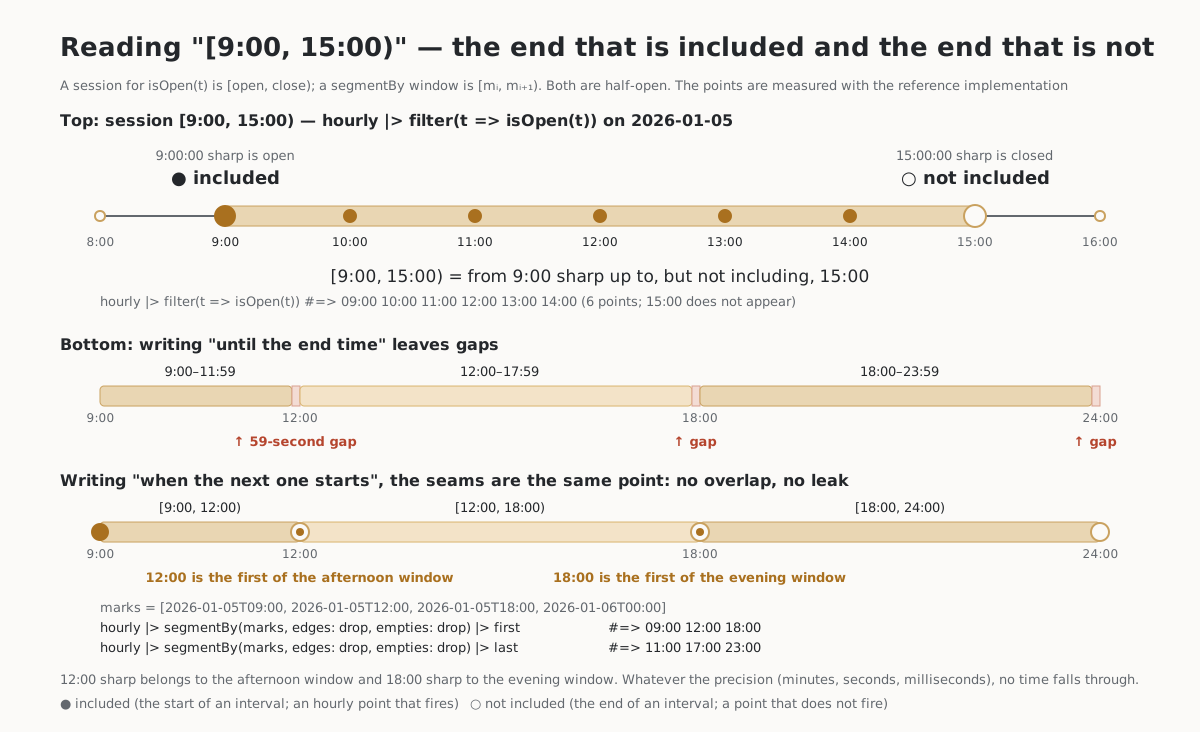
Unlike the partition type, exhaustiveness is not guaranteed, so the two arguments that state the meaning of the gaps explicitly are mandatory declarations (I5; omission is a static error). This closes off, by syntax, the accident in which firings silently vanish on missing data (ADR-15’s “accidental empty”).
Arguments
| Argument | Value | Meaning |
|---|---|---|
m |
stream expression | the markers (the intervals’ boundary points) |
edges: |
drop / clip / error |
treatment of points before the first marker / after the last marker (discard / make a partial window / error) |
empties: |
keep / drop / error |
treatment of zero-element windows between markers (keep as a legitimate empty / discard / error) |
labels: |
list (literal / list binding name) or the cyclic form cycle list anchor: real-day (ADR-47, below) |
a parallel label list for the window sequence (ADR-39); reading is binding-name projection name(d). For the combination constraints see “Preconditions and tightening rules” below — it cannot combine with edges: clip, empties: drop, or label: |
label: |
lambda (p => expr) |
a computed label per window (ADR-34; for index expressions and conditional computations that do not fit labels:) |
Examples
Lunisolar months cut at new moons — take the first day (the new-moon day) of each month. Lunar New Year 2026-02-17 appears:
# eval: 2026-01-01..2026-05-01
@JP
newMoons = [2026-01-19T04:52, 2026-02-17T21:01, 2026-03-19T10:23, 2026-04-17T20:52]
lunarStart = newMoons |> snapTo(day)
everyDay |> segmentBy(lunarStart, edges: drop, empties: drop) |> first
#=> 2026-01-19 2026-02-17 2026-03-19
#~> 範囲外 2026-01-01..2026-01-19(newMoons covering 2026-01-19T04:52..2026-04-17T20:52)
#~> 範囲外 2026-04-17..2026-05-01(newMoons covering 2026-01-19T04:52..2026-04-17T20:52)
With edges: drop, nothing past the last marker 4/17 becomes a window (no silent continuation at
the data’s edge).
labels: — a parallel label list for the window sequence (ADR-39)
Binds a data label sequence to the window sequence. Reading is binding-name projection —
name(d) returns the label of the window that point d belongs to (defining equation
name(d) ≡ labels[window-sequence ordinal]; in the window-sequence ordinal, the window starting at
the first marker within the effective coverage is 0). A same-length check runs at evaluation:
list length == window count (the window count is coverage-based = the marker count, independent
of the evaluation range and the materialization range) — forgetting to update markers and labels as
a pair breaks loudly as a static error (the vessel for F62):
# eval: 2026-01-01..2026-07-01
@JP
newMoons = [2026-01-19T04:52, 2026-02-17T21:01, 2026-03-19T10:23, 2026-04-17T20:52]
  covering: 2026-01-19..2026-04-30
lunarMonth = everyDay |> segmentBy((newMoons |> snapTo(day)), edges: drop, empties: error,
                                   labels: [12, 1, 2, 3])
lunarMonth |> first |> filter(d => lunarMonth(d) == 1)
#=> 2026-02-17
#~> 範囲外 2026-01-01..2026-01-19(newMoons covering 2026-01-19..2026-04-30)
#~> 範囲外 2026-05-01..2026-07-01(newMoons covering 2026-01-19..2026-04-30)
Preconditions and tightening rules (all static errors; ADR-39 decision 4): it cannot combine with
edges: clip (pseudo-windows shift the ordinals); it cannot combine with empties: drop (removing
empty windows compacts the ordinals); it cannot coexist with a label: lambda (doubling the label
source); it does not attach to rule markers (infinite sequences of the week class — periodic
labels go to cycle, computed numbers to ordinalIn or label:);
composite markers (t1 | t2) split the effective coverage so the window count is not determined —
fix it first with a binding-postfix coverage claim (covering:). The reading port for an empty
window’s label (empties: keep) is interval membership — any point within the window interval,
in practice the marker point itself (the form in which an absent period’s number still stands). For
several parallel sequences (numbers and names) the canonical form is separate window bindings
over the same markers (the check bites twice;
../../stdlib/kyureki.md (Japanese) §1).
labels: cycle — a periodic label for the window sequence (ADR-47)
The shape “window sequence = the calendar’s unit, label = a fixed period” (the twelve branches of
sekki-cut months, the monthly nine stars, the moon’s twelve signs) is written with the cyclic
form labels: cycle list anchor: real-day. The semantics are identical to cycle
on a window binding — “the window containing the anchor carries the first label”
(list[(window-sequence ordinal − anchor window's ordinal) mod N]; negatives normalized by the
modulus). No same-length check is imposed — as the covering grows over multiple years and
markers increase, the anchor stays and the expression does not change by a single character
(compatibility with external supply 〈ADR-46〉 is the aim of this form).
# eval: 2026-02-03..2026-02-06
@JP
setsu = [2026-01-05, 2026-02-04, 2026-03-05, 2026-04-05] covering: 2026-01-05..2026-04-05
sekkiMonth = everyDay |> segmentBy(setsu, edges: drop, empties: error,
                                   labels: cycle [寅, 卯, 辰, 巳, 午, 未, 申, 酉, 戌, 亥, 子, 丑]
                                   anchor: 2026-02-04)
everyDay |> filter(d => sekkiMonth(d) == 寅)
#=> 2026-02-04 2026-02-05
- The window of the anchor (Risshun 2/4) is 寅 (Tiger) — the window before it (Shōkan 1/5–) becomes 丑 (Ox) by negative-modulus normalization.
anchor:is part of the form (mandatory; do not cut it off with a comma). Coinciding with a marker point is not required — the containing window decides. An anchor falling on the head side or out of coverage is an explicit error (if a yearly coverage update removes the anchor’s window, advance the anchor by one list period 〈N windows〉 to the corresponding real day — all labels stay unchanged).- Reversing the list writes a retrograde period (the monthly nine stars). A list binding name is also allowed (symmetric with the static form).
- Only the phase declaration is guarded — mid-sequence marker insertions/omissions, or misuse
on a non-periodic sequence (lunisolar month numbers — a leap month repeats the preceding
month’s number), silently rotate the labels with no error and no annotation (there is no
reference list to check against, so machine detection is impossible in principle). For
non-periodic data labels use the static
labels:(its same-length check guards paired updates) — or, for externally supplied data, thelabel:projection (next section), whose expression stays unchanged as coverage grows. Checking the contents is the job of doctests andcoincides.
label: (ADR-34)
The parenthesized named-arg segmentBy(m, edges:, empties:, label: (p => expr)) attaches a
computed label to each window (p = the window’s first point; lazy evaluation at projection
time). When merely pasting a data column, labels: is canonical (ADR-39, ADR-30 revised); label:
is for computations involving index expressions and conditions
(../../stdlib/kyureki.md (Japanese) §7 (5)).
Externally supplied data labels — the form whose expression stays unchanged as coverage grows
(reflux mail 20 §2, 2026-09-03): receive the markers through external and attach its
label column (supplied together with the dates under the same-length contract of ADR-30) with
label: (p => markerTable(p)). p is the window’s first point — the marker point itself — so the
projection returns that marker’s label as is. Even for non-periodic data labels such as lunisolar
month numbers (a leap month repeats the preceding number), the same-length check lives on the supply
contract’s side (契約違反: labels は時点列と同長), and the text of the expression does not change
with the yearly coverage update — “if the date is authoritative, so is the label that names it”,
realized with the existing machinery:
# eval: 2026-02-15..2026-02-22
# resolve: saku = dates 2026-01-19 2026-02-17 2026-03-19 2026-04-17 2026-05-17 covering: 2026-01-01..2026-05-31 asof: 2026-09-03 labels: m12 m1 m2 m3 m4
premise L { calendar-system: Gregorian; tz: "Asia/Tokyo"; wkst: Mon; source: "moon/saku"
  saku  = external(kind: dates, labels: [m1, m2, m3, m4, m5, m6, m7, m8, m9, m10, m11, m12])
  lunar = day |> segmentBy(saku, edges: drop, empties: keep, label: (p => saku(p)))
}
@L
everyDay |> filter(d => lunar(d) == m1)
#=> 2026-02-17 2026-02-18 2026-02-19 2026-02-20 2026-02-21
When the supply grows by one new moon (2026-05-17 with m4), lunar simply gains one window and
the definition above is untouched (measured: with five new moons, m1 = 30 days, m2 = 29 days,
m3 = 4/17–5/16). The value-domain declaration labels: [m1, …, m12] is static knowledge (a leap
month repeats a name inside the domain). A point sequence derived by filter carries no labels
(labels are properties of tables and windows — ADR-30/34/42), so the projection does not stand when
the new moons are filtered out of another table — supply the new moons as their own external
(if you already compute them upstream, just ship the dates and the month numbers together).
Using labels as numbers (reflux regular mail 2026-09-08 §3): the value domain of labels: is
enumeration names (labels: on external accepts identifiers only — ADR-30’s value-domain
declaration is static knowledge), so a definition that does arithmetic on a label, such as a lunisolar
month number, keeps a name-to-number function inside the premise: monthLabelNo = l => l == m1 ? 1 :
l == m2 ? 2 : … : 12 (a nested conditional; the readability cost is explicit). In the supplier’s
measurement the rokuyō (大安) definition written this way matched the static labels: version point
for point. A one-word projection that takes the ordinal from the declaration order (something like
ord(lunar(d))) is not in the 1.0 vocabulary; it is a post-1.0 candidate in
90-open-questions.
⚠ Give this function a name that does not collide with a standard word — monthNo is a public word of the
standard Gregorian premise, used both by the label projection of month (stdlib/gregorian.md §1) and as the
calendar-coordinate value function (§2). Redefining it inside a premise collapses every month-number read into the
default branch of the conditional (== 12 matches every day of the window; anything else matches nothing; no
warning). In the Gregorian with { … } form month(d) is affected too; a direct monthNo(d) call collapses even
in a flat premise (measured in the reflux urgent mail of 2026-09-23 — the supplier renamed their function and this
page renamed its example).
Pitfalls
- Omitting
edges:/empties:is a static error. There is room to fold “frequently used pairs” into sugar (ADR-23), but core always states them explicitly. - When a coarse unit sequence is cut by finer markers, membership is decided by the representative point (for a window element, its first point) (spec §5.2).
- Even a
segmentBy-made window whose cuts are periodic and whose exhaustiveness and non-overlap can be shown is certified partition-type by the I5 check and can be used withwithin— the standardweekis the example (day |> segmentBy(weekStart, edges: clip, empties: error); stdlib/gregorian.md §4.5). - An anchor coarser than the markers can land in the unintended previous window — with
instant-class markers (new-moon/solar-term instants not passed through
snapTo(day)), a date-literal anchor starts at 00:00, which precedes the marker’s time = interval-belongs to the previous window (no error; the phase shifts by one window). The practical form is an anchor that went through the same snap as the markers, or a literal with a time of day (ADR-47). - The head side (coverage start through the first marker) is out-of-coverage for the window
sequence (ADR-37 revision 3) — in an
edges: drop/errorwindow sequence whose first marker sits after the coverage start (the typical shape of filter-derived markers: filtering a 12-point table down to 4 points keeps the coverage while the first marker moves back), labels projections andcoincideson head-side points answer with an out-of-coverage annotation (the filter canonical form drops those points and annotates). To exclude the head side from the coverage itself, put a narrowing covering claim on the derived binding (starts = setsu |> filter(…) covering: 2026-02-04..). - The
label:projection form has no length check — a staticlabels:binding stops on “label count ≠ window count”, butlabel:has no length constraint, so one missing supply point (a missing major solar term) silently turns into a leap month and shifts rokuyō by a day. Put the month-number continuity check in the supply path (reflux regular mail 2026-09-23 §2-2, measured by the production adopter). - A window binding with
labels:supports window-instance reference (value-argument application, ADR-42) —sekkiW("立春")is all days of the interval of the 立春 (Risshun) term (the 2/4–2/18 class), a different thing from the table projectionsekki |> filter(s => sekki(s) == 立春)(the point of Risshun). If you want the point, filter the table; if you want the days of the interval, use the window-instance reference. Note too that number labels are not unique keys (lunarMonth(6)includes the leap sixth month — a repeat of the preceding month’s number — as the union of all matches; with the name labelkyuMonth("六月")the leap sixth month stays distinct). - The end of the final window closed at the coverage edge is undetermined (ADR-37 revision 6) — the window starting at the
final marker is laid up to the coverage edge (membership and start are settled), but the true window may continue past the edge.
Stages that read the end (
last;nthwith too few elements in the known part;first/nthon an empty known part;coincideswithout a witness) attach an out-of-coverage annotation over the whole window — the coverage’s last day fromlunarMonth |> laststays as a candidate, and the annotation says the end is undetermined (before: the coverage’s last day came out as “month-end” with no annotation). Stages that read the start or membership (first, a satisfiednth, labels projections,ordinalIn) are unchanged. Extending the coverage removes the annotation (stdlib/kyureki.md §7).
Related
within · snapTo (granularity-matching the markers) ·
cycle (periodic labels) ·
table literals (bringing marker data in) · ADR-07/08/15 · I5.
A segmentBy window sequence borne by rule markers (no coverage annotations) is accepted as an
effective partition for within’s w and for split’s parent and by: (ADR-48;
the term is in spec §6.3) — regular period cuts like the 4-4-5 fiscal calendar’s “periods” can be
written in either the segmentBy canonical form or the split form (worked example: the
recipe “4-4-5 fiscal calendar”; the extensional match on the
split side is the weekPart doctest on the split page).