coincides — the window-membership predicate
Translated from the canonical Japanese page reference/coincides.md. The
source_shaabove records the source revision; a consistency check flags this page when the Japanese original changes.
Category: projection (body layer §4.9; value function) / Signature:
coincides(S, w, d) : point -> Bool / name settled (2026-07-09, the F51 batch confirmation;
the compared candidates hits/anyIn/sharesWindow were not adopted)
Meaning
Whether at least one point of stream S lies within the w window that point d belongs to
(a boolean). Where ordinalIn counts within the containing window, coincides
asks whether something is there in the containing window — point → containing window → the
window’s contents, the same skeleton as the projection family, bringing bounded existential
quantification into value expressions (ADR-38). The argument order is 〈subject, window, point〉,
isomorphic to ordinalIn(u, w, d) — but the first argument is the family’s only stream (a
binding name, a qualified name, or a parenthesized inline expression. Placing a window word at S
is a static error — implicit demotion to the atomic point sequence is a trap that trivializes the
predicate to true. If a point sequence is intended, write month |> first). w is a window word
resolved in scope (partition-type and segmentBy windows both work; cycle names do not).
This is the vessel for F68: applying exception days to timed and mixed schedules cannot be
written with the equality combinators (snapTo crushes the firing time) — an explicit
means of joining by membership is needed. Being a value predicate, it composes freely with
not, and/or, and other projections (“exclude holidays, but keep Fridays” =
not coincides(holidays, day, d) or weekday(d) == Fri).
Example (the canonical form of F68: drop ad-hoc closure “days” from a 9:00 every-business-day notification)
Note that this “tick + coincides” pattern collapses to one word via the stdlib sugar
at (… |> at(T09:00) — its expansion is exactly this canonical form. ADR-51); what
follows is the canonical example for understanding the expansion.
The 9 o’clock tick is wall clock (stepping by a civil-time width. ADR-38 revised — the old form
shift(+9, unit: hour) has elapsed-time semantics and drifts from the wall clock on DST transition
days, so it was demoted from canonical; it remains the explicit form when “9 elapsed hours later”
is the intent). Exclusion is judged by coincides on “day” membership (the firing time 09:00 is
preserved):
# eval: 2026-01-05..2026-01-10
premise Cal {
  calendar-system: Gregorian
  tz: "Asia/Tokyo"
  satSunC = everyDay |> filter(d => weekday(d) == Sat or weekday(d) == Sun)
  nonWorking = satSunC
}
premise Biz {
  calendar-system: Gregorian
  calendar: Cal
  tz: "Asia/Tokyo"
  wkst: Mon
  nineTick = everyInstant |> strideBy(1d, from: 2026-01-01T09:00)
}
@Biz
closures = [2026-01-07] covering: ..
nineTick |> filter(t => coincides(bizDay, day, t) and not coincides(closures, day, t))
#=> 2026-01-05T09:00 2026-01-06T09:00 2026-01-08T09:00 2026-01-09T09:00
Where a day-aligned derived form stands, differencing in a preceding stage is plainer (same result. ADR-38 decision 8 — the necessity of coincides narrows to directly written tables, mixed schedules, and irregular times):
# eval: 2026-01-05..2026-01-10
premise Cal {
  calendar-system: Gregorian
  tz: "Asia/Tokyo"
  satSunC = everyDay |> filter(d => weekday(d) == Sat or weekday(d) == Sun)
  nonWorking = satSunC
}
premise Biz {
  calendar-system: Gregorian
  calendar: Cal
  tz: "Asia/Tokyo"
  wkst: Mon
  nineTick = everyInstant |> strideBy(1d, from: 2026-01-01T09:00)
}
@Biz
closures = [2026-01-07] covering: ..
bizx = bizDay \ closures
nineTick |> filter(t => coincides(bizx, day, t))
#=> 2026-01-05T09:00 2026-01-06T09:00 2026-01-08T09:00 2026-01-09T09:00
Note that if the entity declares its opening times, this very form collapses into the single
standard-derivation word bizOpen (ADR-41 — ad-hoc closures go to the right-hand side
of nonWorking).
The intersection form is the same single word — “keep only the days that have a point of S” =
filter(d => coincides(S, day, d)). Difference and intersection are written apart by the presence
or absence of not. An example of the net gain in expressive power (execution-verified in
impl/test/coincides.test.ts):
# leap-month detection — a lunisolar month containing no chūki (major solar term) is a leap month
# (doubles as the cross-check for the hand-maintained monthNos updates, F62)
lunarMonth |> first |> filter(p => not coincides(chukiDay, lunarMonth, p))
#=> 2025-07-25 (the first day of the leap sixth month)
The witness rule — the three-way branch of determination (ADR-38 decision 4)
The criterion is always the effective coverage (the complement of the transported annotated
intervals; table literals’ covering:, ADR-37), never the raw covering:
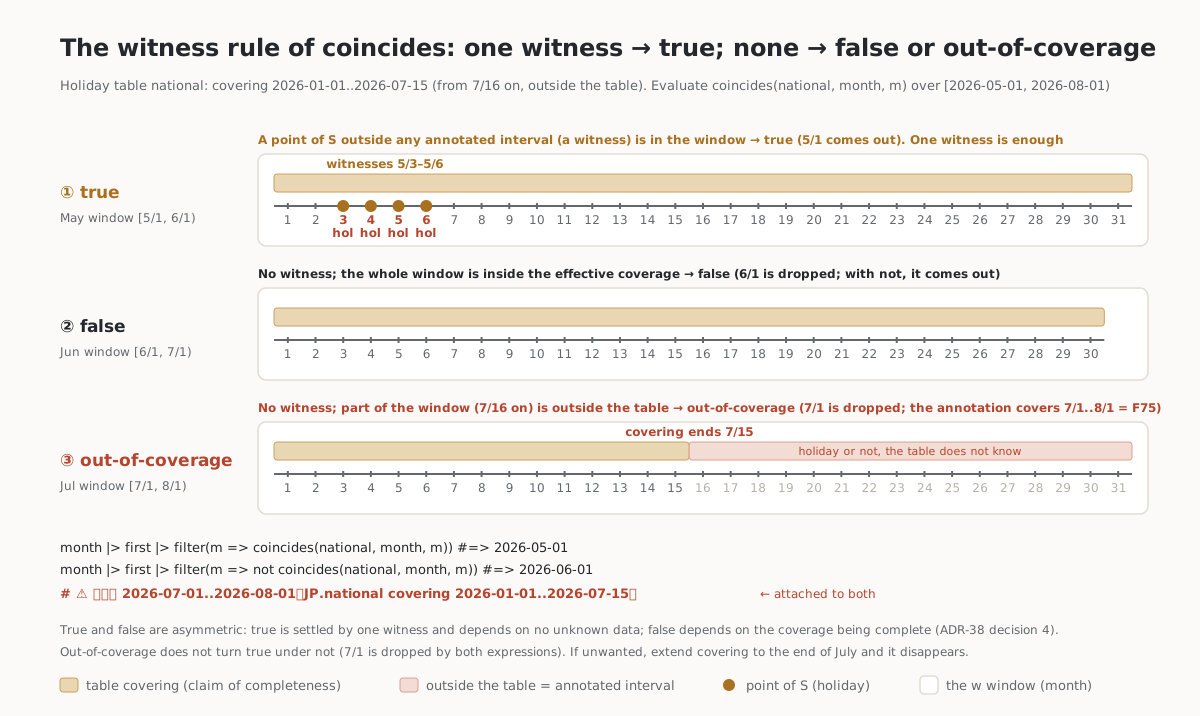
- true: a point of S from an unannotated interval (= a witness) is in
d’s window. ∃ is monotone — a witness’s existence depends on no unknown data (no annotation needed). - out-of-coverage: no witness, and the window intersects an annotated interval of S. Inside
filter, the point is dropped and annotated — the annotation widens to the whole window that was read (F75, ADR-37 revision 2). In pure-value context, an explicit error classified out-of-coverage. - false: the window lies entirely within the effective coverage (determining false depends on coverage completeness — the asymmetry with true is normative).
- The final window closed at the coverage edge (the final window of a data-derived window sequence = its end undetermined) is
always out-of-coverage without a witness — never settled as false (the true window may continue past the edge. ADR-37
revision 6). This closes the shape where leap-month detection
lunarMonth |> first |> filter(p => not coincides(chukiDay, lunarMonth, p))reported a false leap month in the final month (before: false → true undernot).
Points of the degenerate tail of everyDay \ holidays are not witnesses — no “confident true”
is built on top of holidays that may not exist (the consumer-side face of the rule “annotations
attach to non-empty results too”).
Pitfalls
- A tz-name mismatch is a static error (when S’s alignment is a civil-time grid; width and
phase stay unexamined — this is membership, so refinement is allowed).
coincidesis chronos membership, not membership by “the same date label” — for cross-tz, first unify the tz withrebase, then feed coincides (F69 = settled by ADR-40). S with alignment “none” (timed, mixed) is legal, with no check. - For exception days between day-aligned streams the combinator remains right
(
schedule \ blackoutDays). Rewriting to coincides grows a legal bypass of the alignment check — a worsening. The norm: same point — combinator (align a mismatch with snapTo); same membership (day) — coincides. - A cycle name (
weekday, etc.) cannot stand atw— a cycle is a label, not a window (ADR-21). - A window word cannot stand at S (the implicit-demotion trap — if a point sequence is
intended, make it explicit with
month |> first). But a specific instance’s point sequence is fine: a window-instance reference is the explicit demotion —coincides(year(2020), day, d)is legal (ADR-42; S is a stream-expecting position). - If
dbelongs to no window ofw, the error classifier applies (outside the effective coverage = out-of-coverage; inside = hard error. ADR-37 decision 6). - Even if
dbelongs to a window, if that window is stretched outside the marker coverage (the side of a composite marker of theopenTick | closeTickclass whose one component’s covering has run out), it is out-of-coverage — the window boundary itself is unknown, so before any question of witnesses, drop and annotate (a consequence of ADR-37 decisions 4/6. F82; ordinalIn/epochOrdinal/label projection behave the same).
Related
filter (the composition target) ·
combinators (the right road for equality membership) ·
snapTo (aligning points) ·
ordinalIn (the “counting” side of the same skeleton) · ADR-36/37/38 ·
F68/F69/F75.