snapTo — map to the first point of the containing window (floor)
Translated from the canonical Japanese page reference/snapTo.md. The
source_shaabove records the source revision; a consistency check flags this page when the Japanese original changes.
Category: point transform (body-layer core) / Signature: snapTo(w) : Stream -> Stream /
name settled (RC2 · spec §5.4)
Meaning
Maps each point to the first point of the w window it belongs to (floor). The operator
that aligns granularity seams — dropping timed astronomical events (the instant of a solar term,
the instant of a new moon) onto “their day”, folding a timed sequence to the start of “its month”,
and so on.
It stands in a complementary relation, with a different entrance, to the public boundary words
(monthStart = month |> first = window → point) — snapTo is point → point (of the containing
window) and passes through no selector (settled as a basic word in ADR-30 (6)).
Second role (ADR-36): because the output constructively aligns to w’s element grid, it
doubles as the explicit means of conformance for the combinators &/\ and the
axis-membership alignment checks (spec §4.5). On points already aligned it is identity — only the
alignment claim is reattached.
Examples
Drop the instant of Risshun (2/4 05:02) onto its calendar day:
# eval: 2026-01-01..2026-03-01
@JP
sekki = [2026-01-05T17:23, 2026-01-20T10:45, 2026-02-04T05:02]
  covering: 2026..2026
  labels: [小寒, 大寒, 立春]
sekki |> filter(s => sekki(s) == 立春) |> snapTo(day)
#=> 2026-02-04
The instant of a new moon to the new-moon day (the date used as the boundary of a lunisolar month):
# eval: 2026-01-01..2026-02-01
@JP
newMoons = [2026-01-19T04:52]
newMoons |> snapTo(day)
#=> 2026-01-19
#~> 範囲外 2026-01-01..2026-02-01(newMoons covering 2026-01-19T04:52..2026-01-19T04:52)
Pitfalls
- A new moon at 21:01 also floors to that day (no rounding up). If a “carry to the next day”
convention is wanted, write it explicitly:
snapTo(day) |> shift(+1, unit: day). - Distinct points belonging to the same window fold into one point (streams are sets).
- Under non-total windows (window sequences with holes, such as a
segmentBywindow withedges: drop), a point may belong to no window. The behavior is the three-way out-of-coverage fork (ADR-37): if the point is outside the window data’s effective coverage, drop it and annotate the interval; outside the materialization horizon, a warning; a gap inside the coverage is a static error (“snapTo: point outside windows” — a detector for corrupted data or a mixed-up expression; it never passes silently). - Label projections (
sekki(s)) read the original point — after snapping, the point is no longer an element of the table and cannot be read. Write read-then-map, in that order (the example above). -
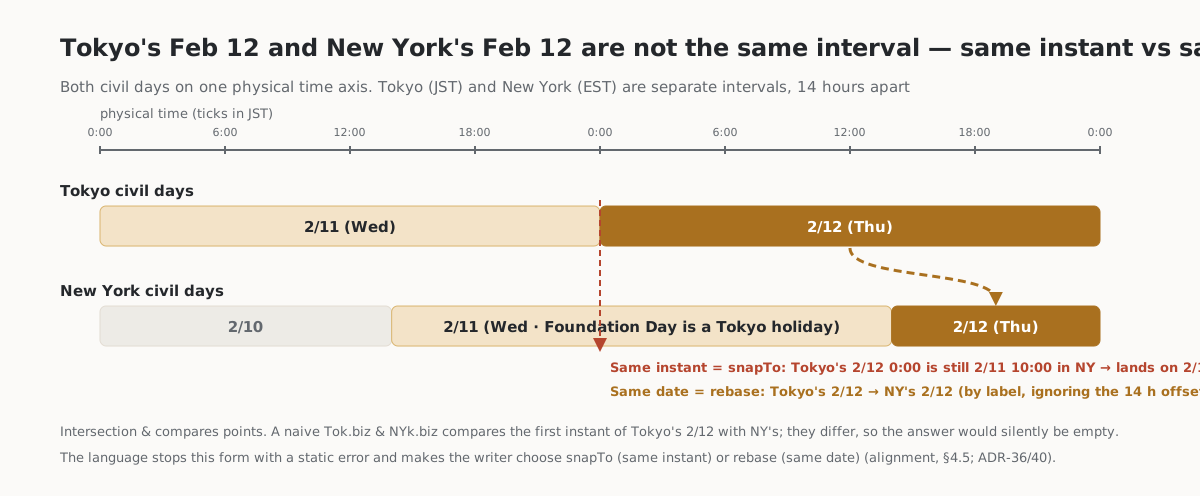
snapTo is chronos membership (floor into the window containing the same instant) — across tzs, the first point of a Tokyo day lands on the previous day in NY (a systematic one-day shift; that is the chronos fact). The means of conformance are three: for the same instant, snapTo; for the same date,
rebase; for timed membership,coincides(for cross-tz, first unify the tz with rebase). - A point moved across the edge of the evaluation range is not in the output — evaluated over
[2026-08-15, 2026-09-01), 8/20 snaps to 8/1 undersnapTo(month), which is outside the range, so it disappears (the semantics are range clipping, spec §7.8). The reference implementation emits the warningwindow-clip: snapTo …(1.0 addendum 22). Evaluate over a wider range.
Related
shift · rebase (re-anchoring by date-label correspondence) ·
segmentBy (cut at snapped markers) ·
combinators (the means of conformance for alignment checks) ·
public boundary words (spec §3.6) · ADR-27/30/36.