isOpen / bizOpen / bizClose — the business-hours standard derivations
Translated from the canonical Japanese page reference/isOpen.md. The
source_shaabove records the source revision; a consistency check flags this page when the Japanese original changes.
Category: standard derivations of a calendar entity (ADR-41) / Signature:
isOpen(t) : Bool (value predicate) · bizOpen/bizClose : Stream (derived streams) / all names
settled (2026-07-09, the F51 batch confirmation; the supply side was renamed from opens/closes
to sessionOpens/sessionCloses and settled = ADR-41 revised). Normative:
spec §3.9.1, ADR-41.
Meaning
When the in-scope calendar: entity C has the paired reserved public words sessionOpens and
sessionCloses (the opening sequence and the closing sequence = the business-hours supply
convention; declared as facts in the civil coordinates = wall clock of the entity’s tz;
optional), the language prescribes uniformly:
bizOpen— the points of C.sessionOpens whose opening day (a civil day in C’s tz) is a business day of C.bizClose— each bizOpen session’s closing point.isOpen(t)— whether t lies in the union of the bizOpen sessions’ half-open intervals[open, close).
The derivations are entity-relative — the decision inputs (which days are off; which tz the
times are read in) resolve in the entity’s culture and do not depend on the reader’s premise
(bizDay = the consumer-relative day axis plays a different role. Whether
the TSE is open is a fact decided by the TSE’s culture alone — readable even by a cross-tz reader
without tripping the tz check). A session’s business-day-ness is read from its opening day —
an overnight session’s (open 22:00, close 03:00 the next day) tail follows its opening day (a
Friday-night session is still open in Saturday’s small hours; a Sunday-night session is off in its
entirety).
Examples
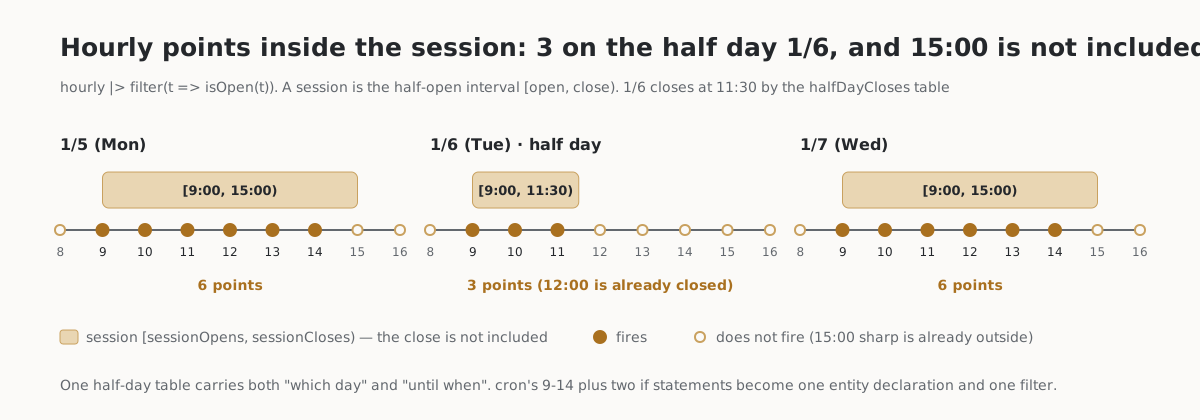
A single session 9:00–15:00, a half-day holiday (1/6 closes at 11:30), a holiday on 1/1. “Every
full hour within business hours” is the single word isOpen (the hand-built band-plus-witness
pattern of ../../design/40-examples/06-business-hours.md (Japanese)
§6.3 collapses into this one word):
# eval: 2026-01-05..2026-01-08
premise TSE {
  calendar-system: Gregorian
  tz: "Asia/Tokyo"
  source: "example"
  satSunC = everyDay |> filter(d => weekday(d) == Sat or weekday(d) == Sun)
  holidays = [2026-01-01] covering: 2026..2026
  nonWorking = satSunC | holidays
  nine  = chronos grid 1d anchor: 2026-01-01T09:00
  three = chronos grid 1d anchor: 2026-01-01T15:00
  halfDayCloses = [2026-01-06T11:30] covering: 2026..2026
  sessionOpens  = nine |> first
  sessionCloses = (three |> first |> filter(t => not coincides(halfDayCloses, day, t))) | halfDayCloses
}
premise JP2 {
  calendar-system: Gregorian
  calendar: TSE
  tz: "Asia/Tokyo"
  wkst: Mon
  hourly = everyInstant |> strideBy(1h, from: 2026-01-01)
}
@JP2
hourly |> filter(t => isOpen(t))
#=> 2026-01-05T09:00 2026-01-05T10:00 2026-01-05T11:00 2026-01-05T12:00 2026-01-05T13:00 2026-01-05T14:00
#=> 2026-01-06T09:00 2026-01-06T10:00 2026-01-06T11:00
#=> 2026-01-07T09:00 2026-01-07T10:00 2026-01-07T11:00 2026-01-07T12:00 2026-01-07T13:00 2026-01-07T14:00
“Fire at each business day’s open” = bizOpen itself (the canonical form after the ADR-38
revision — 1/1 (holiday) and 1/3–1/4 (Sat–Sun) drop out):
# eval: 2026-01-01..2026-01-08
premise TSE {
  calendar-system: Gregorian
  tz: "Asia/Tokyo"
  source: "example"
  satSunC = everyDay |> filter(d => weekday(d) == Sat or weekday(d) == Sun)
  holidays = [2026-01-01] covering: 2026..2026
  nonWorking = satSunC | holidays
  nine  = chronos grid 1d anchor: 2026-01-01T09:00
  three = chronos grid 1d anchor: 2026-01-01T15:00
  sessionOpens  = nine |> first
  sessionCloses = three |> first
}
premise JP2 { calendar-system: Gregorian; calendar: TSE; tz: "Asia/Tokyo"; wkst: Mon }
@JP2
bizOpen
#=> 2026-01-02T09:00 2026-01-05T09:00 2026-01-06T09:00 2026-01-07T09:00
Pitfalls
- Supply comes as a pair (declaring only one is a static error; under
withderivation the judgment includes inheritance). Using a derived word on an entity that declares no sessionOpens/sessionCloses is a static error. Wherecalendar:is in scope, all three words are reserved names (a manual binding is a static error). - The consistency check is data-relative (ADR-41 decision 2): over the joint effective
coverage ∩ materialization range, adjacent markers must alternate in kind (an isolated
close/open at an edge is legal as a notch). For a simultaneous open/close both points must
exist, and their order is unique from context (close→open = continuous operation / open→close
= zero width) — the handling of simultaneous firing belongs to the firing layer. Align the
heads of the pair (supply etiquette = F92): make both
grid(from the epoch), or give bothstrideBythe same day infrom:. With one sidestrideBy(from: 2026…)and the othergrid, the unannotated “no markers before from:” interval enters the check’s domain and the alternation check can error falsely (a norm comes once a real case stands — for now, etiquette). - Boundaries are half-open: at the opening instant the session is open; at the closing instant it is not.
- Coverage: when the decision depends on annotated intervals of sessionOpens, sessionCloses, or nonWorking, it is out-of-coverage (filter drops and annotates — past where the half-day-close table’s covering runs out there is no silent extension. The vessel for F82).
- 24-hour operation is outside this vessel — express all-day operation at day granularity
(
bizDay,coincides(bizDay, day, t)) and declare no sessionOpens/sessionCloses. - Attribution is fixed to the opening day — CME-Globex-class “trade-date attribution” (Sunday open = Monday trade date) is written by supply-side composition in the entity (an attribution knob is F90, awaiting demand).
- Value functions are not first-class values — the point-free
filter(isOpen)cannot be written; write the lambdafilter(t => isOpen(t))(same ascoincides).
Related
nonWorking (the entity; bizDay = the consumer-relative day axis) ·
coincides (the window-membership predicate — isOpen is a derived form of the
same family) · grid (a time-of-day anchor = wall-clock ticks; ADR-31 revision 2) ·
strideBy · shift (elapsed-time preserving — the wall clock belongs
not here but to the declaration side) · spec §3.9.1 · ADR-41 / ADR-31 revision 2 · F67/F79/F85/F89.