rebase — date-label-preserving re-anchoring
Translated from the canonical Japanese page reference/rebase.md. The
source_shaabove records the source revision; a consistency check flags this page when the Japanese original changes.
Category: point transform (body-layer core — the fourth member alongside roll/shift/snapTo) /
Signature: rebase(to: "tz") : Stream -> Stream / name settled (2026-07-09, the F51 batch
confirmation; the compared candidates relabel/sameDate were not adopted)
Meaning
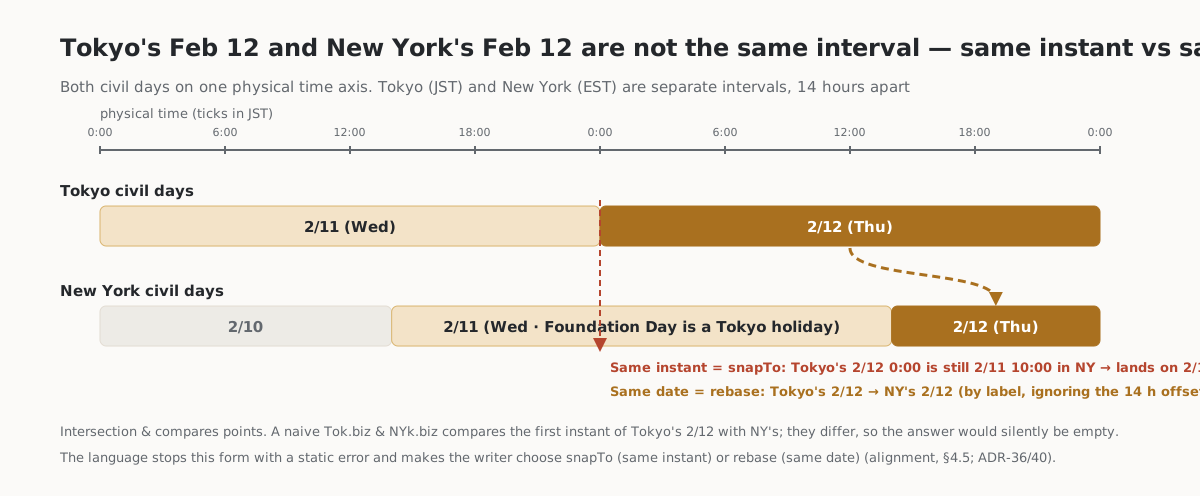
Takes the date label (Y-M-D) of each input point (the first point of a civil day in the
source tz) and maps it to the first instant of the civil day with the same date in the to tz
(ADR-33 decision 4 — the rule is defined even for days whose midnight falls into a DST gap). Date
order is the same order regardless of tz, so the map is injective and order-preserving. The
source tz is taken from the input’s alignment — the input is required to carry the
default-alignment day grid (width 1d, in-day offset 0, with a tz name); anything else (no
alignment, anchored, or with a time-of-day offset) is a static error. source == to is identity.
The output alignment is the day grid of the to tz (constructive; the alignment table of
ADR-36).
This is the vessel for F69: cross-tz composition of “the same date” cannot in principle be
written with chronos equality (snapTo is chronos membership — Tokyo’s day heads
floor to the previous day in NY, a systematic one-day slip). The choice among means of
conformance is threefold:
- the same instant (chronos membership) →
snapTo - the same date (label correspondence) →
rebase - timed membership (is it inside the window?) →
coincides— for cross-tz, first unify the tz withrebase
Example (canonical form: the joint business days of TSE × NYSE)
# eval: 2026-01-01..2026-01-13
premise Tok = Gregorian with {
  source: "test-tokyo"; asof: 2026-01-01
  tz: "Asia/Tokyo"
  hol = [2026-01-01, 2026-01-12] covering: 2026..2026
  ss  = everyDay |> filter(d => weekday(d) == Sat or weekday(d) == Sun)
  biz = everyDay \ (ss | hol)
}
premise NYk = Gregorian with {
  source: "test-ny"; asof: 2026-01-01
  tz: "America/New_York"
  hol = [2026-01-01, 2026-01-19] covering: 2026..2026
  ss  = everyDay |> filter(d => weekday(d) == Sat or weekday(d) == Sun)
  biz = everyDay \ (ss | hol)
}
premise UNY { calendar-system: Gregorian; tz: "America/New_York"; wkst: Mon }
@UNY
(Tok.biz |> rebase(to: "America/New_York")) & NYk.biz
#=> 2026-01-02T14:00 2026-01-05T14:00 2026-01-06T14:00 2026-01-07T14:00
#=> 2026-01-08T14:00 2026-01-09T14:00
#~> 範囲外 2026-01-01..2026-01-01T14:00(Tok.hol covering 2026-01-01..2026-12-31, asof 2026-01-01)
#~> 範囲外 2026-01-01..2026-01-01T14:00(NYk.hol covering 2026-01-01..2026-12-31, asof 2026-01-01)
rebase declares the “label correspondence” realignment, while & stays the existing chronos
equality — both sides pass the alignment check (ADR-36) on NY’s day grid. The output is NY’s date
sequence (display uses the execution tz — here the default Asia/Tokyo — so NY’s day heads appear
as T14:00; 1/12 is Tokyo’s Coming-of-Age Day and drops out of the intersection).
Pitfalls
wis fixed to day (not taken as an argument). Generalizing to month/year is many-to-one and breaks injectivity — redesign if a real case appears (ADR-40 decision 2).- A nonexistent date is an explicit error (the data-relative layer): re-anchoring onto a day erased outright by a date-line move (Pacific/Apia’s 2011-12-30 and the like) cannot be written (ADR-40 decision 3).
- Time-preserving re-anchoring is a future extension — timed sequences are stopped statically
by the input alignment check (the day-grid requirement). Timed cross-tz narrowing can be written
as the composition of
rebasepluscoincidesafter tz unification (there is no expressiveness gap). shift/rollgo before rebase — window words such asunit: dayafter a rebase resolve in the in-scope premise and therefore disagree with the to tz’s grid (the norm of ADR-40 decision 7).to:is a string literal naming a tz (a premise name is not allowed — using a premise to name nothing but a tz is a mix-up face of “what was it aligned to”. ADR-40 decision 5). Versions and gap rules follow the in-scope evaluation context.- rebase makes cross-tz alignment routine — the receiving exempt family (
within,ordinalIn, selectors, cycle/value projections) carries the tz-name check (ADR-36 revision 2), so flowing on without rebase becomes a static error in the form of “bundling with a one-day label slip, weekday reading” (the error guides toward rebase).
Related
snapTo (chronos membership), coincides (the window-membership
predicate), combinators (composition by equality),
shift/roll (the norm of going first), ADR-33/36/40, F69.