nonWorking — the calendar entity’s reserved public word and the bizDay standard derivation
Translated from the canonical Japanese page reference/nonWorking.md. The
source_shaabove records the source revision; a consistency check flags this page when the Japanese original changes.
Category: calendar entity (premise layer) / Identity: the public word
nonWorking : Stream (argument-less; day-aligned in the entity’s tz) / nonWorking is a
settled name (2026-07-09, the F51 batch confirmation). Normative: spec §3.9, ADR-35.
Meaning
A calendar entity — what stands at the calendar: member — is a premise that has the reserved
public word nonWorking (the non-working set). There is no dedicated syntax: an ordinary premise
definition, plus the designation of “which binding is the non-working set”, is all. The identity
check (an extension of ADR-19) requires:
- the public word
nonWorking(time-stream type; an argument-less binding; aligned to the civil-day grid of the entity’s tz) - a
tz:declaration (required — fixes the data’s civil days on the inside. ADR-33)
As governance separate from the identity check — the usual rule for premises containing tables —
source: is declaration-required leaning and the edition is carried by asof: (declaration
recommended where reproducibility matters. ADR-26).
Once the user side stands an entity at calendar:, the standard derivation prescribed uniformly
by the language becomes available: bizDay = everyDay \ C.nonWorking (everyDay resolves on the
user side; C.nonWorking is pinned to the entity). Where calendar: is in scope, bizDay is a
reserved derived name (a manual binding is a static error).
Examples
Declare an entity and read business days through the standard derivation bizDay (1/1 is a
holiday; 1/3 and 1/4 are Sat–Sun. The closed-day data is simplified for the example — the real TSE
is also closed over the year-end/New Year period 12/31–1/3):
# eval: 2026-01-01..2026-01-08
premise TSE {
  calendar-system: Gregorian
  tz:     "Asia/Tokyo"
  source: "jpx.co.jp/trading-calendar"
  asof:   2026-01-05
  satSun     = everyDay |> filter(d => weekday(d) == Sat or weekday(d) == Sun)
  holidays   = [2026-01-01] covering: 2026..2026
  nonWorking = satSun | holidays
}
premise Tokyo {
  calendar-system: Gregorian
  calendar:        TSE
  tz:              "Asia/Tokyo"
  wkst:            Mon
}
@Tokyo
everyDay |> filter(on: bizDay)
#=> 2026-01-02 2026-01-05 2026-01-06 2026-01-07
Naming the entity directly at an axis position (on: TSE ≡ on: bizDay in the context of
calendar: TSE. F53, ADR-35) — if payday the 25th falls on a Sunday, the preceding business day:
# eval: 2026-01-01..2026-02-01
premise TSE {
  calendar-system: Gregorian
  tz:     "Asia/Tokyo"
  source: "jpx.co.jp/trading-calendar"
  satSun     = everyDay |> filter(d => weekday(d) == Sat or weekday(d) == Sun)
  holidays   = [2026-01-01] covering: 2026..2026
  nonWorking = satSun | holidays
}
premise Tokyo {
  calendar-system: Gregorian
  calendar:        TSE
  tz:              "Asia/Tokyo"
  wkst:            Mon
}
@Tokyo
everyDay |> within(month) |> nth(25) |> roll(Preceding, on: TSE)
#=> 2026-01-23
#~> 範囲外 2026-01-01..2026-01-02(TSE.holidays covering 2026-01-01..2026-12-31)
Organization-local overriding uses the existing with (overriding source: as well —
declaration-required leaning):
premise MyCompany = TSE with {
  source:     "intra.example.com/holidays"
  nonWorking = TSE.nonWorking | companyHolidays    # base references use the qualified pin
}
The entity’s members are readable from body expressions by qualified reference (ADR-17 “qualify when ambiguous”; the answer to F100 of the third feedback batch — the day-before-a-holiday-reminder class is writable with no new reserved names. Bare names resolve premise-relative, so an entity’s contents are not exposed automatically = as designed):
# eval: 2026-01-02..2026-03-01
premise Cal { calendar-system: Gregorian; tz: "Asia/Tokyo"; wkst: Mon; source: "hr-db"
  holidays = [2026-01-01, 2026-01-12, 2026-02-11] covering: 2026..2026
  satSun = everyDay |> filter(d => weekday(d) == Sat or weekday(d) == Sun)
  nonWorking = satSun | holidays
}
premise Use { calendar-system: Gregorian; tz: "Asia/Tokyo"; wkst: Mon; calendar: Cal }
@Use
Cal.holidays |> shift(-1, unit: day)
#=> 2026-01-11 2026-02-10
Pitfalls
- Timed points cannot be placed in
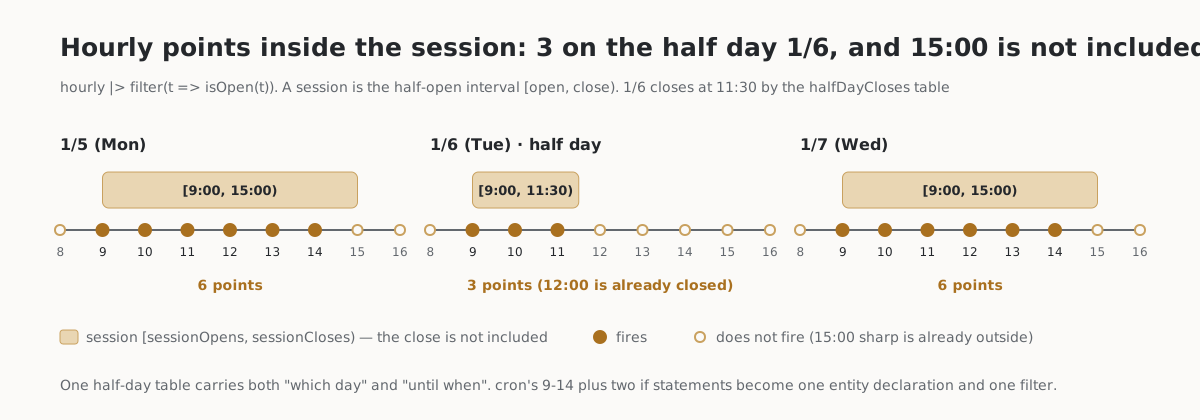
nonWorking(identity check = day alignment; the ground on which the ADR-36 checks and the standard derivation mesh). Half-day holidays and business-hour bands live in the same entity as the paired reserved public wordssessionOpens/sessionCloses, read through the standard derivationsbizOpen/bizClose/isOpen(ADR-41 — those are entity-relative; the role difference from consumer-relative bizDay is in isOpen.md). - If the entity’s
tz:and the user side’stz:disagree, the standard derivation is stopped by the alignment check (spec §4.5) (the correct behavior of F54). The explicit formeveryDay \ (TSE.nonWorking |> snapTo(day))means “read the overlap on chronos through the user side’s day boundaries” — not reconciliation of “the same date label”; for that, userebase(ADR-40). - Cascades (substitute holidays, Mainland China’s tiaoxiu) are composed on the right-hand side of
nonWorking(ADR-01 — filtering appears only at the final stage of the standard derivation). - Out of
calendar:scope,bizDayremains a free binding name (existing manual-binding styles keep working).
Related
Combinators (cascades, alignment checks) ·
filter/roll (naming an entity directly at an axis position) ·
with (organizational overriding) ·
table literals (source:/covering:) · spec §3.9 · ADR-35/36.